Generative AI × 3D Printer Complete Guide: Text-to-3D Tool Comparison, CAD Integration, and Practical Workflow — 2026 Edition
swiftwand swiftwand.ai
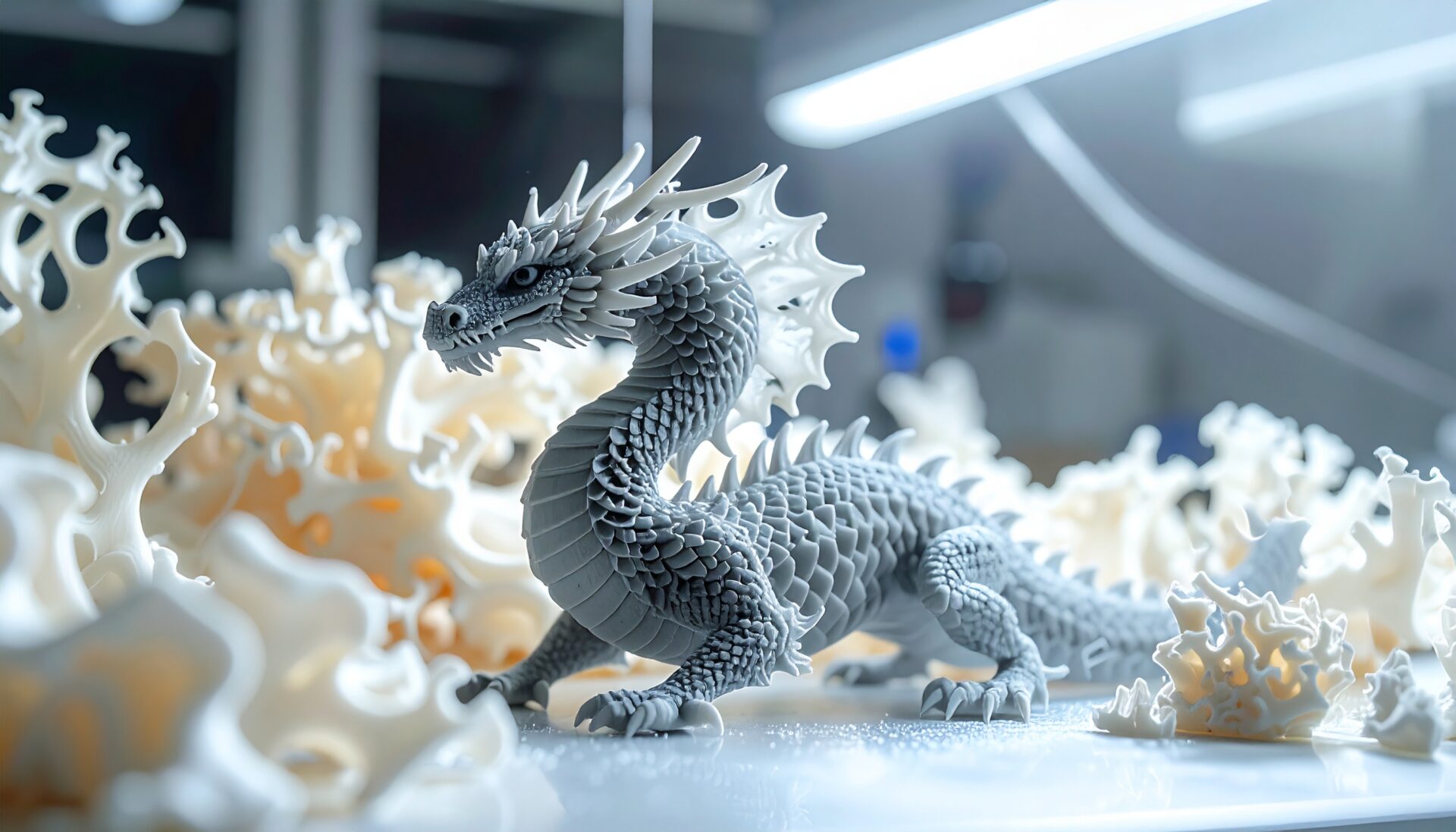
Support structures are one of the biggest headaches in 3D printing. Complex shapes require supports, but they bring material waste, tedious removal, and degraded surface quality. The global 3D printing market has reached $26–30 billion in 2025, with desktop FDM growing at 23.8% CAGR. Yet industry surveys show that about 41% of waste material in FDM printing comes from support structures—a major burden in both material costs and post-processing time.
This article covers next-generation AI-powered support generation technology: from conventional methods to Dendrite-GAN, slicer AI feature comparisons, soluble support challenges, and a practical implementation guide for dramatically reducing material waste.
Traditional slicers detect overhang angles (typically 45°+) and uniformly generate supports. This often produces excessive support material—20–40% of total material usage can be support. For a 100g print, roughly 33g becomes support that gets discarded. Over a year, individual users waste several kilograms, while corporate prototyping departments lose tens of kilograms.
Support removal is mostly manual, requiring 30 minutes to several hours per print for complex shapes. Surfaces where supports contacted the print show visible marks, significantly degrading quality. Additional sanding and filling often follow.
Incorrect support settings can cause supports to detach mid-print, failing the entire job. Bridges and steep overhangs are particularly sensitive—support density and pattern choices directly determine success or failure.
Dendrite-GAN is a deep learning model that revolutionizes support structure generation. Named after neural dendrites, it generates branching support structures that minimize material while maximizing structural integrity.
The first stage simulates physical forces during printing—gravity sag, thermal warping, and layer adhesion strength. Unlike traditional slicers that use simple angle thresholds, this module considers material properties (PLA and ABS behave differently), print speed, and nozzle temperature. This prevents unnecessary support generation on areas that can actually print without support.
For locations identified as needing support, the GAN generates optimal structures. The Generator creates support candidates while the Discriminator evaluates quality—through this adversarial process, structures converge on minimum material with maximum support force. This is a conditional GAN (cGAN) application: 3D model shape data and physics predictions serve as inputs, and optimized support structures come out.
Dendrite-GAN’s ultimate goal is zero-support printing. While currently limited to certain geometries, combining print orientation optimization with support structure minimization already achieves dramatic reductions in support material usage.
Forked from Bambu Studio, OrcaSlicer offers highly customizable tree supports. Organic tree supports dramatically reduce material compared to grid-pattern supports. Also features auto-calibration for flow rate and pressure advance, improving overall print quality.
UltiMaker’s veteran slicer. Teton Simulation’s Smart Slice plugin enables FEM-based simulation for parameter optimization. Continuously improved tree support algorithms and an active community creating custom support patterns.
Bambu Lab’s native slicer excels at printer integration. LIDAR sensor scans the initial layer to detect support adhesion quality in real-time. Combined with AI camera monitoring, it catches support detachment issues early.
Prusa Research’s slicer prioritizes stability and reliability. Supports tree supports with ongoing organic support algorithm improvements, but AI features are modest compared to competitors. Advanced features rely on hardware (SuperPINDA probe, etc.).
PVA (polyvinyl alcohol) dissolves in water but has serious drawbacks: extreme moisture sensitivity (degrades within days of opening), dissolution takes hours to 10+ hours depending on temperature and agitation, and requires a dual extruder—driving up equipment costs.
HIPS dissolves in limonene (citrus solvent) and pairs with ABS. However, limonene is expensive, dissolution is slow, requires ventilation, and HIPS has limited compatibility with PLA and PETG.
As AI support optimization advances, dependency on soluble supports drops significantly. Auto-optimizing print orientation minimizes overhangs, and minimizing tree support contact areas makes even standard PLA/ABS supports easy to remove. This reduces material costs and simplifies post-processing simultaneously.
In 3D printing sustainability, support reduction has major impact. PLA is technically biodegradable but only in industrial composting facilities—most ends up in landfills. ABS and PETG have limited recycling infrastructure. If AI-optimized 35% support reduction were adopted industry-wide, thousands of tons of annual plastic waste reduction is projected. Even individual users printing 10 times monthly can save 1–2kg of filament annually through tree supports and orientation optimization.
Advanced AI models like Dendrite-GAN are still in research and not yet integrated into consumer slicers. However, OrcaSlicer’s tree supports and Cura’s Smart Slice plugin offer optimization benefits you can use right now.
Print orientation optimization is the simplest and most effective approach. Rotating a model to reduce overhangs can cut support volume by 50%+ in many cases. Use slicer preview to check while adjusting.
PVA for PLA-based prints, HIPS for ABS-based prints. However, with AI support optimization, soluble support usage drops significantly—standard supports suffice for an increasing number of cases.
Research papers use thousands to tens of thousands of 3D model/print result pairs. Personal training isn’t practical, but once pre-trained models are published, fine-tuning for your environment will become feasible.
Topology optimization is deterministic with clear theoretical foundations but slow. GAN-based methods learn from data to quickly propose diverse structures but require separate physical validation of generated results.
For certain shapes and materials, supportless printing already works. As AI orientation optimization and material property prediction advance, applicable range will steadily expand. However, complete supportless printing for complex internal structures remains challenging for now.
AI support generation technology is rapidly evolving as a fundamental solution to 3D printing’s material waste problem. From research-level Dendrite-GAN to immediately usable features like OrcaSlicer’s tree supports and Bambu Lab’s LIDAR scanning, AI benefits can be adopted incrementally. Start with orientation optimization and tree supports today, accumulate data with AI monitoring tools, and prepare for advanced AI support optimization ahead. The era of simultaneously reducing material costs, shortening post-processing, and improving print quality is just around the corner.
For more information, visit All3DP.