Hybrid Fabrication Complete Guide 2026: CV-Powered CNC × 3D Printing × Laser — Snapmaker Artisan, DMG MORI, Workflows, and FAQ
- The Trinity of Manufacturing: Hybrid Fabrication Directed by Computer Vision
- Why Hybrid Fabrication, Why Now?
- How Computer Vision Transforms Machining Precision
- Consumer Hybrid Machines: The Snapmaker Artisan
- Hybrid Workflow Practical Guide
- Industry-Specific Hybrid Fabrication Use Cases
- Business Applications: Generating Revenue with Hybrid Manufacturing
- Software Ecosystem: The Toolchain from Design to Fabrication
- Industrial vs Consumer: Hybrid Machine Comparison
- 5 Checkpoints Before Starting Hybrid Manufacturing
- Hybrid Manufacturing Roadmap: 2026 and Beyond
- Frequently Asked Questions (FAQ)
- Q1. Can individuals buy a hybrid machine?
- Q2. Can computer vision be retrofitted?
- Q3. Can 3D printing + CNC really achieve precision?
- Q4. Which materials are best for hybrid processing?
- Q5. Are there consumer alternatives to Snapmaker?
- Q6. What is the ROI on industrial hybrid machines?
- Q7. What camera is needed for computer vision?
- Q8. What are the future trends in hybrid manufacturing?
- Conclusion: The Future of Manufacturing in a Single Machine
The Trinity of Manufacturing: Hybrid Fabrication Directed by Computer Vision
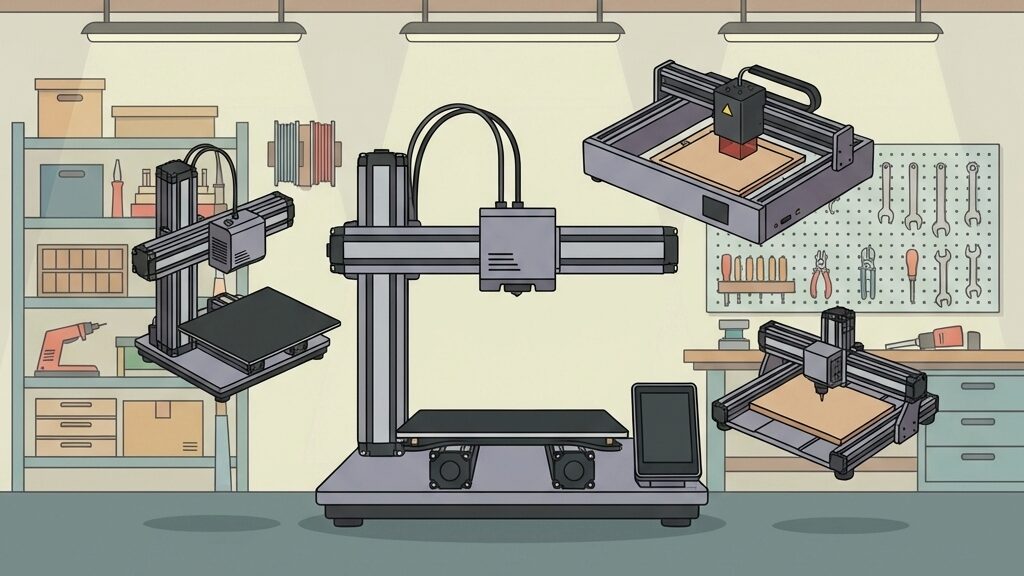
CNC milling, 3D printing, and laser processing — operations that once required three dedicated machines can now be completed on a single hybrid platform. In 2026, the integration of computer vision (CV) technology enables real-time monitoring and automatic correction during machining. Here is the full picture of this “trinity” platform that is fundamentally disrupting manufacturing.
Why Hybrid Fabrication, Why Now?
The challenges facing manufacturing are clear: growing demand for high-mix low-volume production, supply chain decentralization, and labor shortages. The traditional “one process, one machine” model inevitably suffers from transfer losses between processes, setup changeovers, and quality variation.
Hybrid fabrication solves these problems fundamentally:
- Process consolidation: 3D print the rough shape → CNC mill for precision finishing → laser for surface texturing. All completed on one machine in a single setup.
- Material efficiency: Research data shows hybrid CNC systems can reduce material waste by up to 40% compared to CNC alone — a sustainability advantage.
- Cost reduction: Some manufacturers report 40–78% cost reduction for small-lot parts compared to standalone CNC. Elimination of fixtures and reduced setup time are the primary drivers.
The CNC machine tool market is projected to reach $129 billion in 2026, with demand from automotive, aerospace, medical, and defense sectors driving this growth.
How Computer Vision Transforms Machining Precision
The true innovation in hybrid machines is closed-loop control via computer vision (CV). Traditional machine tools simply “move as programmed.” CV-equipped machines can “see, judge, and correct.”
Real-Time Melt Pool Monitoring
In metal additive manufacturing (DED/LMD), a laser melts metal powder to build layers. CV monitors the melt pool’s temperature, shape, and size at thousands of frames per second, adjusting laser power and scan speed in real time. This prevents internal defects like porosity and cracking during the build process.
In-Process Measurement and Automatic Correction
DMG MORI’s LASERTEC DED hybrid machines integrate additive, milling, grinding, and 3D scanning in a single unit. After building, non-contact 3D scanning inspects dimensions, and only out-of-tolerance areas receive additional CNC machining — “adaptive finishing.” At Formnext 2025, blue laser support was also announced for processing reflective metals like copper and aluminum.
AI-Driven Toolpath Optimization
The 2026 generation of hybrid printers integrates neural network-based material processors, real-time correction via laser interferometers, and automatic micro-layer scanning. Fixed toolpaths are evolving into “self-healing toolpaths” that dynamically adapt to machining conditions.
Consumer Hybrid Machines: The Snapmaker Artisan
Industrial hybrid machines require investments of tens of millions of dollars, but options are expanding for individuals and small businesses. The standout is the Snapmaker Artisan.
Snapmaker Artisan Key Specs
- Fabrication modes: FDM (dual nozzle) + CNC milling (200W/18,000RPM) + Laser (40W semiconductor laser)
- Work area: 400mm × 400mm × 400mm (3D printing)
- Compatible materials: PLA/ABS/PETG/TPU/Nylon (3D printing), Wood/Acrylic/Brass/Aluminum (CNC/Laser)
- Laser performance: Cuts 15mm basswood plywood and 20mm pine at 2–3mm/s
- Safety: Enclosure reduces Class 4 → Class 1 laser. Auto-stop on door open, gyro sensor for anomaly detection
- Price: Standard $2,599, Premium (with 40W laser) $2,999
Note that the Artisan currently lacks built-in camera or computer vision features. However, third-party AI monitoring systems like Obico can be added for 3D print failure detection.
Hybrid Workflow Practical Guide
Step 1: Design and CAM
Create 3D models in Fusion 360 or FreeCAD, planning which parts will be additively manufactured and which will be machined. The basic strategy: build rough shapes quickly with 3D printing, then finish precision mating surfaces and screw holes with CNC milling.
Step 2: 3D Print → CNC Milling
First, 3D print the bulk of the part. Leave 0.3–0.5mm machining allowance on surfaces requiring tight tolerances. After printing, swap to the CNC toolhead — on the Snapmaker Artisan, head changes take about 2 minutes. CNC finishing achieves ±0.05mm precision, which is difficult with FDM alone.
Step 3: Laser Processing for Added Value
Finally, use the laser module for surface texturing, engraving, and marking. Logo engraving, serial numbers, decorative patterns — this step elevates the finished product quality. You can also create hybrid products combining laser-cut wood or acrylic parts.
Industry-Specific Hybrid Fabrication Use Cases
- Aerospace: DMG MORI and Mazak 5-axis CNC + DED (Directed Energy Deposition) systems cut titanium alloy structural prototype manufacturing cycles by 60–80%. Near-net-shape building → precision milling → inline inspection in a single setup.
- Medical/Dental: Patient-specific implants and surgical guides built additively in biocompatible titanium, then CNC-finished for precision. CV-based dimensional inspection automates lot-level quality assurance.
- Tooling/Fixtures: “Remanufacturing” — worn mold surfaces are DED-clad, then CNC-finished back to original dimensions. Reported 70–80% cost reduction compared to new tooling.
- Automotive: Ideal for high-mix low-volume custom parts. Integrated production of 3D-printed exterior parts → CNC finishing → laser marking shortens lead times from weeks to days.
Business Applications: Generating Revenue with Hybrid Manufacturing
Even individuals and small businesses can monetize hybrid manufacturing:
- Custom product sales: Sell unique products combining 3D printing + CNC + laser on Etsy or similar marketplaces. Phone cases, signs, and accessories are high-margin targets.
- Prototyping services: Offer local manufacturers and design firms a bundled 3D print prototyping + CNC precision finishing service. Projects in the $500–$3,000 range are realistic.
- Educational content: Hybrid manufacturing tutorials and blogs are niche but have strong search demand. Monetize through both affiliate and ad revenue.
- Repair/Remanufacturing: Scan broken parts → 3D print restoration → CNC finishing. Industrial spare parts demand is substantial.
Software Ecosystem: The Toolchain from Design to Fabrication
CAD/CAM Software
- Fusion 360: Integrates 3D modeling, CAM, and simulation. Ideal for hybrid workflows, managing additive and subtractive processes in a single project. Free for personal use.
- FreeCAD: Open-source 3D CAD with a Path workbench for CNC toolpath generation. Zero cost to get started.
- Snapmaker Luban: Snapmaker’s dedicated integrated software. Manages 3D printing, laser, and CNC modes in a single UI. Intuitive but limited in advanced settings.
AI Monitoring and Quality Control Tools
- Obico (formerly The Spaghetti Detective): AI-based 3D print monitoring. Analyzes webcam footage in real time, auto-detecting spaghetti-type print failures and pausing the job. Free plan available.
- Bambu Lab Handy: Bambu Lab’s proprietary AI print monitoring with integrated timelapse and anomaly detection. Bambu Lab machines only.
- OctoPrint + plugins: Open-source 3D printer management server. Extensible with camera and AI detection plugins for monitoring.
Industrial vs Consumer: Hybrid Machine Comparison
The optimal hybrid machine varies significantly by purpose and budget:
- DMG MORI LASERTEC DED: 5-axis CNC + metal DED + 3D scanning. Blue laser support for reflective metals. CV-equipped for melt pool monitoring and auto-correction. Multi-million dollar range. For aerospace and medical.
- Mazak INTEGREX i-AM: Turning + milling + metal DED. 5-axis simultaneous control for complex geometries. Strengths in large industrial part repair and manufacturing.
- Snapmaker Artisan: FDM + CNC + Laser 3-in-1. 400mm cube work area. No built-in CV but retrofittable. ~$2,599–$2,999. For individuals and small businesses.
- ZMorph Fab: 3D printing + CNC + Laser + thick-film printing 4-in-1. Popular in educational and research institutions. Starting at ~$4,700.
5 Checkpoints Before Starting Hybrid Manufacturing
- Clarify your purpose: Prototyping or production? For prototyping, Snapmaker-class is sufficient. For production, plan staged investment toward industrial machines.
- Confirm your materials: Your target materials determine your options. Plastics favor FDM + CNC; metal machining requires at least a 200W+ spindle for CNC.
- Installation space: The Snapmaker Artisan measures approximately 665mm × 943mm × 705mm (with enclosure). Factor in dust extraction for CNC and exhaust ducting for laser.
- Safety measures: Laser processing is Class 4 — direct exposure instantly damages eyes and skin. Enclosure use is mandatory. Dust goggles and dust collection are essential for CNC.
- Learning curve: Each fabrication mode requires CAM knowledge. Start with Fusion 360’s free tutorials, master one mode, then progress to the next.
Hybrid Manufacturing Roadmap: 2026 and Beyond
Hybrid fabrication continues to evolve rapidly. Near-term trends include multi-material simultaneous processing (integrating polymers, metals, ceramics, and electronics in a single job), digital twin-based virtual test machining, and edge AI for real-time defect prediction.
By 2027 and beyond, “lights-out production” — fully autonomous manufacturing cells operating 24/7 without human intervention — is projected to become reality. Even on the consumer side, AI-controlled toolpath optimization and camera-based auto-calibration will become standard equipment.
Frequently Asked Questions (FAQ)
Q1. Can individuals buy a hybrid machine?
Yes. Consumer 3-in-1 machines like the Snapmaker Artisan (~$2,599–$2,999) exist. Industrial DMG MORI-class machines cost tens of millions, but consumer options are expanding year by year.
Q2. Can computer vision be retrofitted?
For 3D print monitoring, Obico (formerly The Spaghetti Detective) can be paired with a camera for aftermarket installation. CV monitoring for CNC/laser is primarily industrial, and consumer retrofit solutions remain limited.
Q3. Can 3D printing + CNC really achieve precision?
FDM alone typically achieves ±0.2–0.5mm tolerance. Adding CNC finishing brings this to ±0.05mm or better. The best practice is to print with 0.3–0.5mm machining allowance, then CNC-finish to final dimensions.
Q4. Which materials are best for hybrid processing?
Plastic hybrids — printing PLA or ABS then CNC finishing — are the easiest entry point. For metals, aluminum and brass are CNC-friendly; titanium and stainless steel require industrial DED systems. Wood + laser combinations are also popular.
Q5. Are there consumer alternatives to Snapmaker?
ZMorph offers a competing 4-in-1 (3D printing, CNC, laser, thick-film printing). You can also retrofit laser modules onto 3D printers from brands like Creality, though CNC milling capability is typically not included.
Q6. What is the ROI on industrial hybrid machines?
Aerospace reports show hybrid CNC-AM adoption cuts prototyping cycles by 60–80% and reduces small-lot part costs by 40–78% versus standalone CNC. Initial investment payback is typically 2–3 years.
Q7. What camera is needed for computer vision?
For 3D print monitoring, a standard USB webcam (1080p or higher recommended) is sufficient. Industrial melt pool monitoring uses high-speed infrared cameras (thousands of frames per second), but these are typically pre-integrated into the machine.
Q8. What are the future trends in hybrid manufacturing?
From 2026 onward, the industry-wide trend is “autonomy.” Key concepts include robotic tending, self-optimizing toolpaths, edge AI monitoring, digital twins, and adaptive machining. Machines are evolving from “operator tools” to “decision-making assistants.”
Conclusion: The Future of Manufacturing in a Single Machine
Hybrid fabrication directed by computer vision is becoming the new standard in manufacturing. On the industrial side, DMG MORI and Mazak are advancing 5-axis CNC + DED integration. On the consumer side, the Snapmaker Artisan demonstrates the potential of 3-in-1 machines.
With CV-powered real-time monitoring and automatic correction, the quality assurance barrier has dropped dramatically, opening the door to manufacturing for small businesses and individual makers alike. Start your own “trinity manufacturing hub” with a single hybrid machine.