What Is Plaud Note Pro? A Next-Generation AI Voice Recorder for Transcription, Summaries, and Meeting Minutes
swiftwand swiftwand.ai
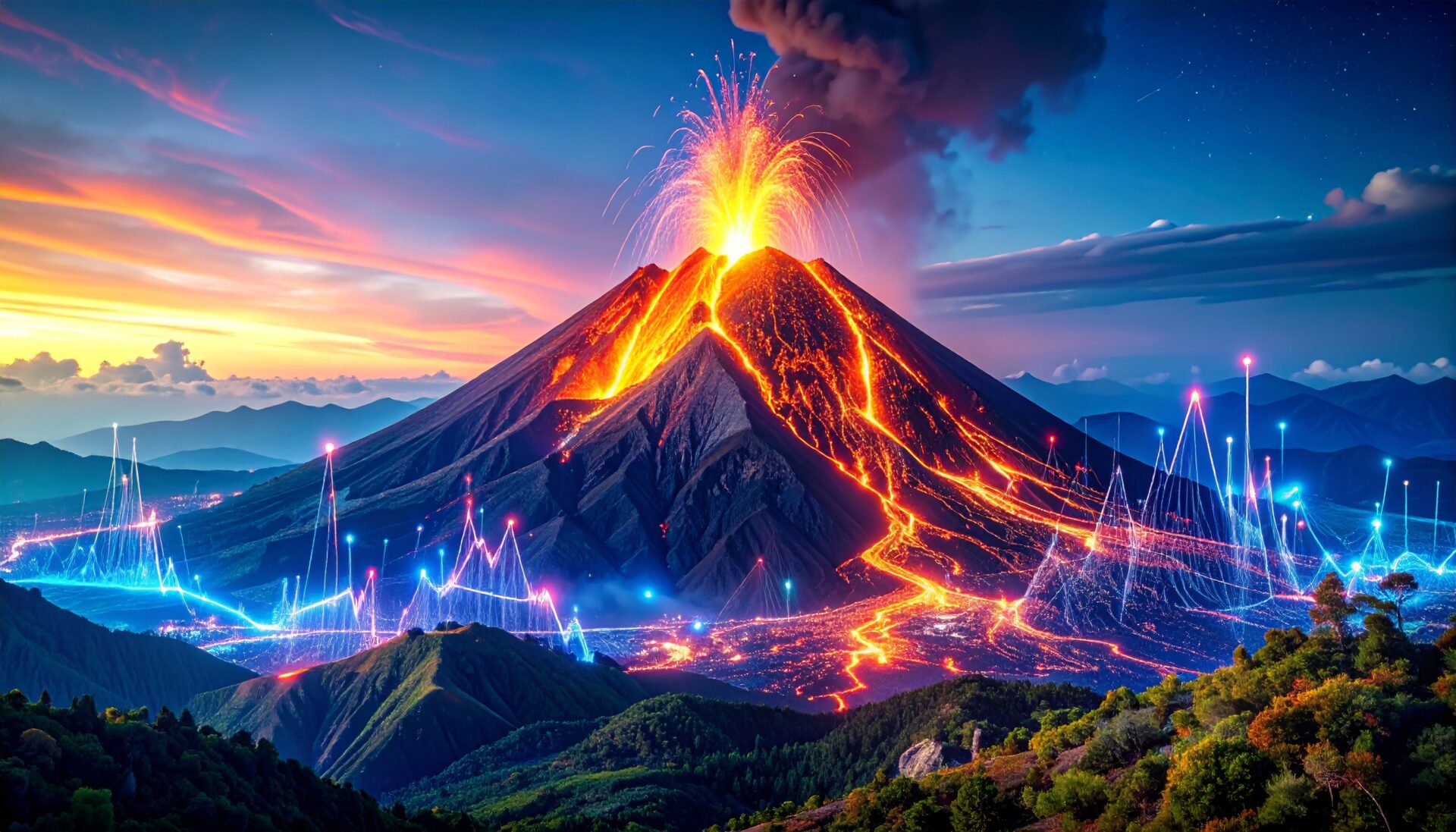
In recent years, volcanic activity has intensified worldwide, raising concerns about damage from unpredictable eruptions. Traditional volcano observation technology often missed subtle precursor phenomena. With the evolution of AI and machine learning, the accuracy of volcanic observation data analysis has dramatically improved. This article explains the latest developments in AI-powered volcano eruption prediction technology and its contributions to disaster prevention.
Volcano observation collects vast amounts of data from diverse sensors including seismometers, tiltmeters, and GPS. While visual analysis by experts was traditionally the mainstream approach, AI technology now enables 24/7 real-time monitoring. Machine learning algorithms compare past eruption patterns with current data to detect minute changes that humans might overlook. For example, the USGS has developed an AI seismic waveform analysis system that distinguishes volcanic earthquakes from regular earthquakes with high accuracy, improving detection of pre-eruption volcanic tremors by approximately 40%.
Machine learning has brought innovations to volcanic observation data analysis in several key areas: integrated analysis of different data types (seismic waves, crustal deformation, gas emissions), extracting meaningful signals from noisy data, learning from past eruption cases to identify similar patterns, and quantitative evaluation of eruption probability. Deep learning in particular has evolved volcanic activity assessment from expert-dependent evaluation to data-driven objective analysis.
Success stories of AI-enhanced volcano observation are being reported worldwide. At Italy’s Mount Etna, a machine learning model identified micro-seismic patterns 48 hours before eruption, improving prediction accuracy by 65% compared to conventional methods. At Hawaii’s Kilauea volcano, AI-based magma movement analysis detected anomalies days before the major 2018 eruption. In Japan, AI-powered automatic volcanic gas composition analysis systems are being tested at active volcanoes like Sakurajima and Mount Asama, enabling faster detection of magma state changes.
AI’s greatest strength is its ability to process large volumes of data in real-time. In volcano observation, where data is updated every second, instant processing is critically important for disaster prevention. Combined with edge computing, data preprocessing at observation sites enables basic analysis to continue even during communication failures. In Indonesia, an AI system installed near active volcanoes near densely populated areas automatically links with local disaster prevention systems to send alerts to residents’ smartphones when eruption signs are detected. During the 2021 Mount Merapi eruption, this enabled evacuation orders approximately 2 hours earlier than conventional methods.
As AI technology evolves, new possibilities are opening in volcano observation—from 3D volcanic monitoring combining satellite data and drone observations to rapid eruption information gathering using social media data. However, AI prediction still faces challenges: limited training data for eruptions, difficulty building universal models due to each volcano’s unique characteristics, and the necessity for human experts to make final decisions. AI should be positioned as a tool that supports expert judgment.
The JMA monitors all 111 active volcanoes in Japan around the clock. While human visual confirmation of seismometer and tiltmeter data was standard, AI introduction has enabled automatic detection of anomalous patterns. Particularly for automatic classification of volcanic earthquakes, work that previously took hours now completes in seconds, significantly reducing monitoring staff workload.
At Sakurajima in Kagoshima Prefecture, demonstration experiments using AI for eruption prediction continue. By training machine learning models on decades of observation data, the accuracy of detecting micro-crustal deformation patterns that occur hours before eruptions has improved. Practical deployment as a system supporting local government evacuation decisions is anticipated.
For Mount Fuji, multiple universities and research institutions have collaborated to build a wide-area monitoring network incorporating AI. By having AI comprehensively analyze diverse data including satellite imagery, GPS crustal deformation data, and hot spring chemical composition changes, more comprehensive volcanic activity assessment is now possible.
The technology for automatically classifying volcanic earthquake waveform patterns using deep learning is advancing rapidly. In traditional manual classification, even experts sometimes disagreed on categorization, but classification using Convolutional Neural Networks (CNNs) has achieved accuracy rates exceeding 90%. This has made it possible to detect specific earthquake types that serve as precursors to eruptions in real time.
By analyzing SAR (Synthetic Aperture Radar) data acquired from satellites using AI, millimeter-level surface deformations can be detected. Since observations are unaffected by clouds, this approach offers the advantage of continuous crustal deformation monitoring even for volcanoes constantly shrouded in volcanic plumes. AI algorithms that automatically compare satellite images from multiple time periods enable early detection of dangerous inflation patterns.
At present, 100% prediction is impossible, and complete prediction is considered extremely difficult even in the future. Volcanic activity depends on the behavior of magma deep underground, and it is not possible to observe every process involved. While AI significantly improves prediction accuracy, final evacuation decisions still need to be made comprehensively by human experts.
Volcanic activity monitoring information can be checked in real time on the Japan Meteorological Agency’s website. Eruption alert level announcements are also based on this system. Additionally, disaster prevention apps provided by local governments allow you to receive volcano-related warnings via push notifications.
The biggest challenge is the lack of training data. Since large-scale eruptions do not occur frequently, it is difficult for AI to learn from sufficient cases. Additionally, because each volcano has unique characteristics, models trained on one volcano cannot be directly applied to another — this is known as the transfer learning challenge. Handling data gaps due to the harsh environments where observation equipment is installed is also an important technical issue.
In Iceland, AI-powered monitoring systems are operational for active volcanic activity, and they contributed to advance warnings during the 2024 Reykjanes Peninsula eruption. Similar systems have been deployed at Italy’s Mount Etna and multiple volcanoes in Indonesia. International research networks are advancing data sharing and collaborative AI model development, strengthening the global volcano monitoring framework.
The Japan Meteorological Agency (JMA) publishes the latest observation data, eruption alert levels, and volcanic activity explanation materials for each active volcano. Eruption bulletins can also be received via email and social media, making this an essential information source to check before mountain climbing. Live footage from volcano cameras is also available, useful for real-time situational awareness.
The National Research Institute for Earth Science and Disaster Resilience (NIED) collects real-time data from its high-density observation network installed across the country and conducts AI-powered analysis. Research results are published as open data and widely utilized in university and private sector research. The fundamental volcano observation network called V-net serves as the foundational infrastructure for Japan’s volcano disaster prevention.
Several disaster prevention apps compatible with JMA’s eruption bulletins have been released for use by hikers. These apps work with GPS location data to deliver push notifications for volcano warnings affecting your current location, and some include evacuation route guidance features. An increasing number of apps also integrate with climbing plan submission functions, making them essential tools for safe mountain climbing.
The first step is to check the volcanic hazard map and determine whether your home falls within the eruption impact zone. Share evacuation routes and shelters with your family, and include volcanic ash countermeasures such as masks and goggles in your emergency kit. Understanding the meaning of JMA’s eruption alert levels and having a pre-planned action plan for each level is crucial.
While AI greatly surpasses humans in processing large volumes of data and detecting anomalous patterns, the role of volcanologists will not disappear. Interpreting AI outputs and making comprehensive judgments remains the work of specialists. In fact, by automating routine analytical tasks, AI allows volcanologists to focus on more creative research and complex decision-making. A collaborative model where AI and human experts leverage each other’s strengths will become the standard for future disaster prevention.
The accuracy of current AI volcano prediction varies greatly depending on the type of volcano and the data used. For frequently erupting volcanoes like Sakurajima, short-term eruption prediction accuracy of approximately 70-80% has been reported. On the other hand, predicting the reawakening of long-dormant volcanoes has not yet reached practical accuracy levels due to insufficient training data. Future development of multimodal AI integrating multiple data sources is expected to further improve accuracy.
Even without large-scale observation equipment, AI analysis using satellite image data is possible at the individual level. Efforts to analyze surface temperature changes using satellite data published by NASA and JAXA with machine learning libraries are spreading within the research community. However, it is recommended that results be treated as academic interest rather than being directly used for disaster prevention decisions.
AI technology has dramatically improved the accuracy of volcanic eruption prediction and made significant contributions to strengthening disaster prevention systems. Multi-faceted approaches including deep learning seismic wave classification, satellite data analysis, and real-time anomaly detection are being put into practical use. However, complete prediction of volcanic activity remains difficult, and AI should be positioned as a tool that complements the judgment of human experts. Going forward, the key will be establishing international frameworks for data sharing and developing AI models adapted to the unique characteristics of each volcano.
さらに詳しい情報はAll3DPでご覧いただけます。