Don't Buy Springs, Print Them: Embedding Computation into Matter with 2026 Metamaterial Engineering
swiftwand swiftwand.ai
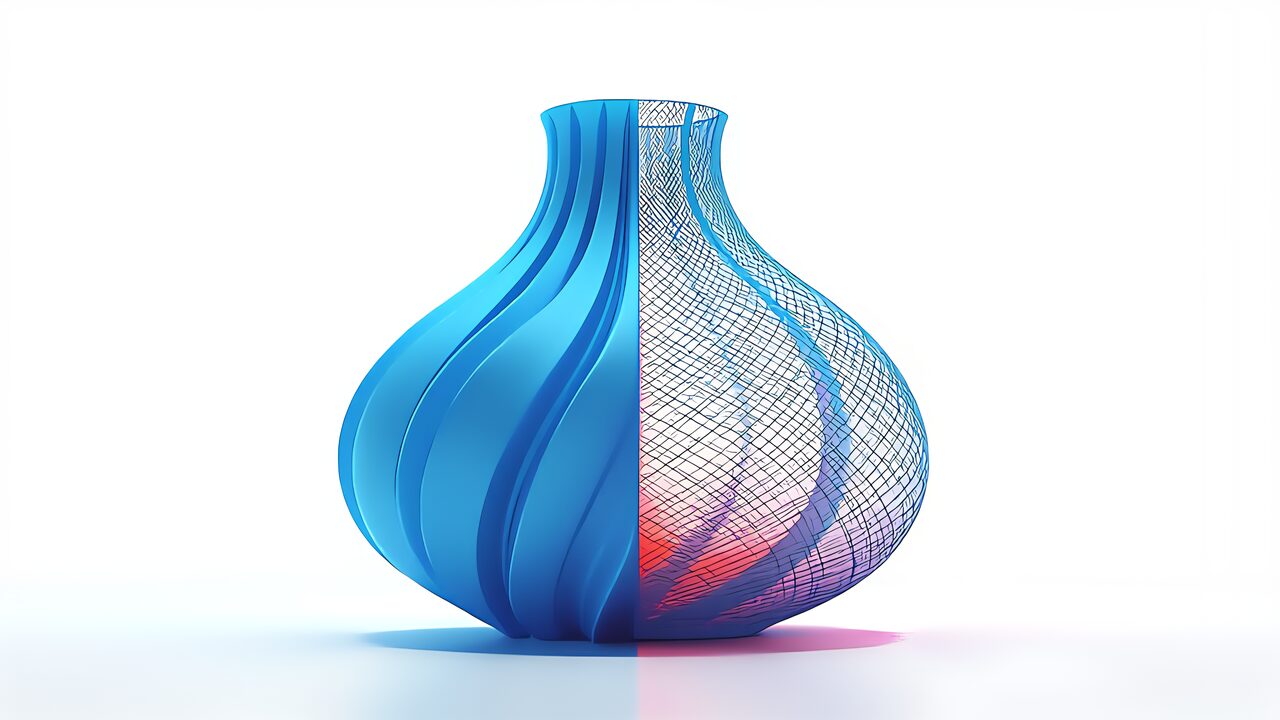
You 3D print a custom-designed vase. The curves are beautiful, and the “likes” pour in on social media. But the moment you fill it with water, the handle snaps off.
This is not a joke. A study by MIT researchers revealed a shocking fact: only 26% of 3D models styled by generative AI were structurally sound. The remaining 74% were “all show, no substance,” unable to withstand everyday use.
In January 2026, a system was announced that solves this problem at its root. MechStyle, developed by Faraz Faruqi, a PhD student in MIT EECS and CSAIL engineer, emerged from a collaboration with Google, Stability AI, and Northeastern University. This system introduces the “eyes of physics” through finite element analysis (FEA), raising structural soundness to up to 100%. Note: MechStyle is currently available as an open-source Blender UI plugin, though it remains a research-stage system. It does not address models that are already structurally unsound before styling.
This article examines MechStyle’s technical architecture and practical workflow. Let us dissect the impact this technology brings to desktop 3D printers.

Text-to-3D and Image-to-3D technologies have advanced dramatically over the past two years. A single text prompt can generate objects with organic curves. For example, Meshy, introduced in a previous article, opened the door to 3D modeling for makers without CAD skills.
However, these tools had a fatal flaw: generative AI does not understand physics.
What happens specifically? Generative AI moves mesh vertices to apply styles. In doing so, it freely deforms structurally critical regions (stress concentration points). It thins vase handles, reduces hook bases, and over-rounds bracket corners. The algorithms pursuing visual “beauty” were simultaneously creating mechanical “fragility.”
This problem is becoming more serious as Text-to-3D commercialization progresses. Community sites like Thingiverse and Printables demonstrate this reality: creators are forced to choose between aesthetic appeal and practical usability.
Until now, there were three main approaches to addressing this problem.
None of these approaches fundamentally resolved the trade-off between beauty and strength. Makers had long suffered from this binary choice.

MechStyle’s innovation is clear: it integrates finite element analysis (FEA) simulation in real time into the generative AI styling process.
The traditional workflow was a cycle of trial and error. Designers repeated “design, print, test, redo.” They would create a model, print it, apply force to discover weak points, then modify and print again. This wasted both time and material.
MechStyle embeds this verification loop inside the design process itself.
Here is how it works.
Through this integration, generative AI generates designs that understand not just “appearance” but also “mechanics.” FEA feedback is reflected in real time, functioning at each iteration of the styling process.
For readers unfamiliar with FEA: finite element analysis is a method that divides complex structural shapes into tiny “elements.” It numerically calculates the force (stress) and deformation (strain) on each element. This technology is widely used in manufacturing, from automobile body design to aircraft wing structures.
As discussed in our AI topology optimization article, FEA is a powerful tool for visualizing “where force concentrates” and “where things are likely to break.” MechStyle directly incorporates this technology into the generative AI styling process, setting it apart from other Text-to-3D tools.
MechStyle’s other key technical contribution is Adaptive Scheduling, a mechanism that dramatically improves computational efficiency.
FEA simulation is computationally expensive. Specifically, it requires dividing a 3D model into thousands or tens of thousands of elements and solving systems of simultaneous equations. Running full FEA at every iteration would make generation times impractically long.
MechStyle addresses this by tracking deformation in each region of the model and re-running FEA only in regions where structural risk increases.
Specifically, a tracker monitors vertex displacement. When cumulative displacement in a region exceeds a threshold, FEA is triggered for that region only. Regions with minimal change skip the physics check entirely. This approach reduces total FEA computation by approximately 60% while maintaining structural safety at the same level as full verification at every step.
The system offers two operating modes.
Freestyle Mode generates styles with no physical constraints, prioritizing pure aesthetics. This mode is useful for initial exploration of design direction and understanding what a given style looks like without structural limitations.
MechStyle Mode integrates FEA into the styling process, generating designs that balance aesthetics with structural integrity. By comparing the outputs of both modes, users can clearly see where and how structural constraints affect the design.

MechStyle’s paper (arXiv: 2509.20571) presents benchmarks conducted across multiple object categories.
Baseline (generative AI without FEA): structural soundness at 26%, high risk of stress-concentration fracture, with failure points at walls thinned by design changes and at joints.
MechStyle (FEA + Adaptive Scheduling): structural soundness up to 100%, uniform stress distribution, aesthetic quality equivalent to baseline, and minimal aesthetic degradation from structural intervention.
The key finding is that MechStyle does not sacrifice design to increase strength. Specifically, it preserves the full styling capability of generative AI while selectively constraining only structurally dangerous deformations. This “optimization by subtraction” produced the dramatic improvement from 26% to 100%.
According to MIT News (January 14, 2026), MechStyle has been validated on many practical items including vases, wall hooks, smartphone stands, and keychains.
The hook example is particularly symbolic. A hook styled with “minimalist Japanese” aesthetics by conventional generative AI had an elegantly thin base. However, it fractured under a 3 kg load test. In contrast, the same style applied through MechStyle automatically preserved adequate cross-sectional area at the base, passing the load test while maintaining equivalent aesthetic quality.
The vase case is also fascinating. When an “organic tree bark” style was applied, generative AI added realistic concave textures to the walls. However, some indentations reduced wall thickness below 0.4 mm, causing leaks when filled with water. The MechStyle version automatically limited indentation depth through FEA, maintaining a minimum wall thickness of 1.2 mm.

MechStyle is currently available as a Blender plugin (research stage). To use it, prepare a 3D model in STL or OBJ format.
Recommended model characteristics:
In MechStyle, you can specify styles via text prompt or reference image. Start with Freestyle mode to generate multiple variations and explore design direction.
Effective text prompt examples: “Art Deco geometric pattern combining straight lines and arcs,” “Organic tree branch texture with surface relief depth of 2 to 5 mm,” “Gothic cathedral-inspired decorative elements with pointed arches.”
For reference images, prepare an image in your preferred style and pass it to MechStyle. The system will extract style characteristics and apply them to the model. Architectural photographs, textile patterns, and natural object textures all work effectively.
After confirming style direction in Freestyle mode, generate the final model in MechStyle mode. The output model has been structurally verified by FEA. You can directly export it as an STL file for your slicer.
Furthermore, users can specify load conditions in this process. For example, setting “this hook must withstand a maximum 5 kg load” allows MechStyle to automatically strengthen the relevant areas while preserving aesthetic quality.
MechStyle output models are already structurally optimized. Therefore, slicer settings can be kept simple.
Recommended print settings (for PLA):
| Parameter | Recommended Value | Reason |
|---|---|---|
| Layer height | 0.16 mm | Balance between curve smoothness and strength |
| Infill density | 20-30% | MechStyle has already optimized the structure, so excessive infill is unnecessary |
| Wall count | 3-4 layers | Ensures outer wall strength |
| Print speed | 100-150 mm/s | Quality maintained with high-speed capable printers |
| Support | Tree support recommended | Best fit for organic shape overhangs |
The key point is that there is no need to over-increase infill density. Previously, many makers would set it to 50% “just to be safe.” However, MechStyle optimizes the external geometry itself, meaning structural strength is achieved through intelligent form rather than material volume.
Accurately reproducing the high-quality meshes output by MechStyle requires stable printing precision. The Bambu Lab P1S (MSRP $699, street price $399 to $499) is particularly well-suited. Its enclosed build chamber provides temperature stability that benefits complex geometries, while its high-speed capability maintains quality at speeds where MechStyle’s optimized designs can truly shine.
MechStyle’s technology has the potential to significantly impact not just individual makers but also industry.
Medical field: In designing prosthetics and splints customized for individual patients, balancing design personalization with structural safety is the most critical challenge. Currently, prosthetic design requires skilled technicians spending days with CAD and FEA. MechStyle’s integrated FEA approach could dramatically shorten this process, enabling the design of stylish, safety-guaranteed splints fitted to patient body types in just hours.
Architecture and interior design: Applications are expected in designing custom 3D-printed lighting fixtures and furniture parts. Designers could pursue creative forms without worrying about structural calculations. For example, structural verification of Voronoi decorative panels and parametric architectural facades could be automated.
Education: MechStyle can serve as an intuitive learning tool for the relationship between design and mechanics in engineering education. Students can observe how FEA results change in real time as they modify styles, helping them visually understand structural mechanics concepts like stress concentration and second moment of area.
MechStyle’s paper has been presented at the ACM Symposium on Computational Fabrication. Research code release is also progressing.
Expected future integration targets include:
Therefore, once the 3D printing community adopts this technology, the situation will change. The preconception that “models made by generative AI are fragile” will eventually become a thing of the past.
Until now, “structurally safe custom designs” were the exclusive domain of engineers proficient in both CAD and FEA. However, MechStyle AI 3D printing technology removes this barrier. By simply entering a text prompt, you can obtain objects guaranteed in both appearance and function.
This mirrors how AI-supported generative technologies solved material waste problems. The design barrier is lowering just as the manufacturing barrier did. In other words, the age is arriving where anyone who can think “I want something like this” can create something that is truly usable.
What MechStyle demonstrated is not merely a technical improvement. It is a paradigm shift: teaching physics to generative AI.
From 26% to 100%. These numbers mean that the reliability of AI-generated 3D models has shifted from “unusable” to “completely trustworthy.”
In the world of MechStyle AI 3D printing, the old trade-off where pursuing “beauty” meant becoming “fragile” is eliminated. Generative AI equipped with the “eyes of physics” through FEA performs structural calculations on your behalf, guaranteeing designs that will not break.
The next time you output a custom design on your 3D printer, worry will be unnecessary. The anxiety of “will this break if I pick it up?” should already be a thing of the past.
References: MIT News: Generative AI tool helps 3D print personal items that sustain daily use; 3D Printing Industry: MIT Unveils MechStyle; arXiv: MechStyle paper; 3Dnatives: MechStyle Blends Generative AI with Mechanical Simulation; ACM Digital Library: MechStyle (SCF ’25)