AI 3D Printing Workflow: The Complete Process from Generated Model to Finished Product
swiftwand swiftwand.ai

Temperature settings. Speed limits. Retraction distance. Infill patterns. The variables determining 3D print quality number in the dozens, and their optimal values shift with material, model geometry, printer individual differences, room temperature, and humidity. Optimizing this vast combinatorial space manually — that’s been traditional slicing.
In our previous article on AI generative design for 3D printing, we explained AI-automated “unbreakable part” design. Even with optimized designs, poor slicing ruins print quality. This article dissects the full landscape of AI slicers in 2026 — the transition from rule-based traditional methods to neural network-driven next-generation slicing.

Specifically, understanding AI slicers 2026 requires rethinking the essence of slicing.
Rule-based slicing is a collection of human-defined “if-then” rules. “Generate supports when overhang exceeds 45°.” “Set fan to 100% when bridge distance exceeds 10mm.” Cura, PrusaSlicer, and OrcaSlicer’s base engines all use this approach. Rules are clear and predictable but can’t account for inter-rule interactions. Raising temperature improves flow but increases stringing. Increasing speed improves throughput but causes ghosting from vibration. These tradeoffs can’t be solved by adding more rules.
Neural slicing “learns” optimal parameters from print result data. Inputs: model geometry, material properties, printer specifications. Output: optimal parameter sets for each segment. Tradeoffs between rules are solved as a unified high-dimensional optimization problem.
Additionally, the current state of AI slicers 2026 is a transitional period where both approaches coexist.
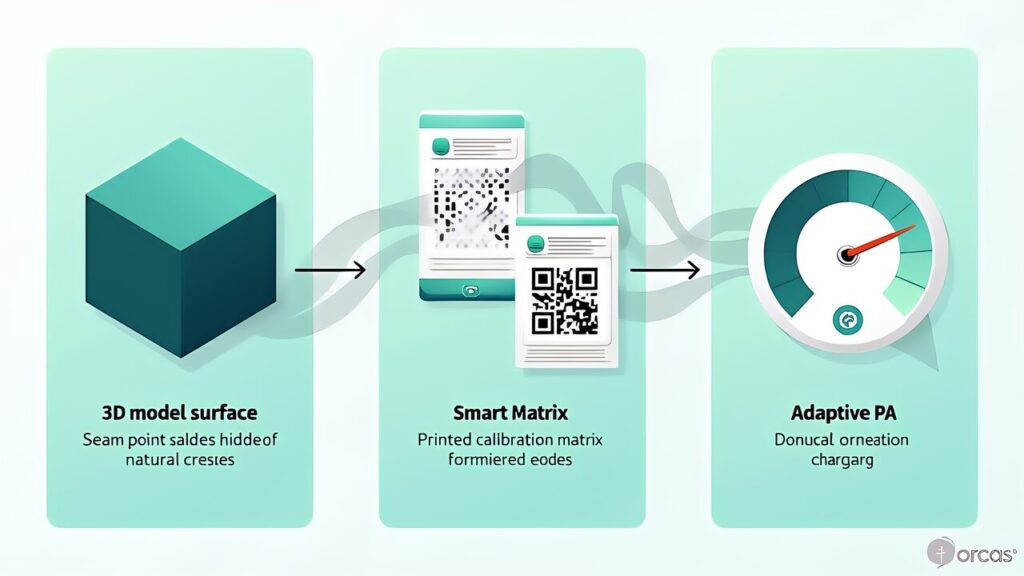
For example, open-source OrcaSlicer is the most practical choice for AI slicers 2026. Free to use, it implements the following AI/neural network features.
Scarf Seam gradually varies extrusion amount at layer-change seams, making them virtually invisible. Combined with Seam Painting, users can manually specify seam placement on the model. While not neural-network-driven, this represents the “intelligent parameter control” philosophy underlying AI slicing.
OrcaSlicer’s calibration suite automatically optimizes Pressure Advance value, flow rate, and temperature in a single workflow. Print calibration patterns, measure results, and apply optimal values — reducing what previously took hours of manual tuning to minutes.
Dynamically adjusts Pressure Advance values based on print speed and acceleration. Models the relationship between flow rate (speed) and PA, estimating optimal PA values for any speed/acceleration combination. This is the closest current implementation to true neural slicing in consumer software.
Generates variable-width perimeters that adapt to model geometry. For thin sections, automatically adjusts extrusion width to fill the space without gaps or overlaps. While algorithm-based rather than neural, it embodies the “place material only where needed” optimization philosophy that prefigures future AI-driven infill generation.
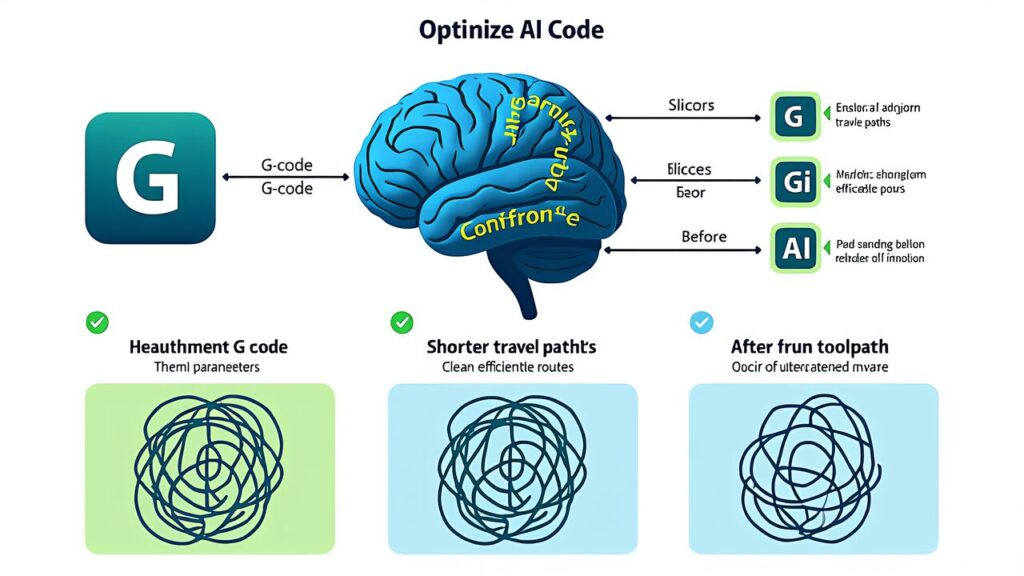
Specifically, another current in AI slicers 2026 is LLM (Large Language Model) post-processing of G-code. As detailed in our LLM G-code Optimization article, methods where LLMs “read, understand, and rewrite” G-code are being researched.
Optimizations include travel path rearrangement (minimizing non-print moves), segment-specific retraction control, and dynamic temperature profile adjustment (varying temperature between large flat areas and fine details).
The advantage: compatibility with existing slicers. G-code from any slicer can be post-processed, eliminating the need to switch slicers. However, API costs and processing time remain bottlenecks — small models take minutes, large models can take tens of minutes.
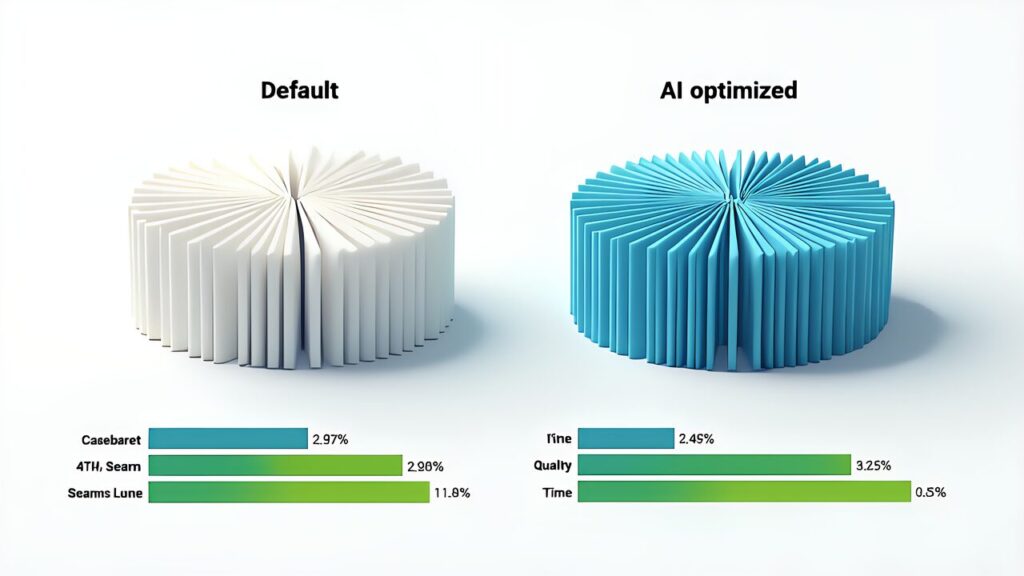
AI slicer neural network optimization doesn’t end at the slicing stage. Integration with firmware control algorithms further improves print quality. The frontline: Klipper firmware.
Additionally, Klipper runs G-code analysis and motion planning on an external computer (Raspberry Pi), sending only stepper motor drive signals to the MCU. This separation architecture enables AI integration.
At high speeds (200mm/s+), printer frame resonance causes ghosting (surface waviness). Klipper’s Input Shaper uses an accelerometer (ADXL345, ~$3) to measure each axis’s resonance frequency and applies filters to motor drive signals to cancel vibrations.
Compensates for the delay between extruder motor movement and actual filament flow from the nozzle. Klipper’s PA algorithm predicts and pre-compensates, maintaining consistent extrusion at speed changes and corners.

The next frontier isn’t optimizing existing parameters — it’s generating entirely new toolpaths that no rule-based system would create. Non-planar slicing, continuous fiber paths, and multi-objective optimization across strength, weight, time, and cost simultaneously.
| Technology | 2026 Status | Impact |
|---|---|---|
| Adaptive PA/Flow | Production (OrcaSlicer) | Immediate quality improvement |
| LLM G-code post-processing | Experimental | 5-15% time/quality improvement |
| Neural non-planar slicing | Research | Strength and surface quality revolution |
| Generative toolpath AI | Concept | Fundamental paradigm shift |
Key Point: The transition from rule-based to AI-driven slicing is happening incrementally. OrcaSlicer’s adaptive features are the practical entry point today, while LLM G-code optimization and neural slicing represent the near future.
For more information, visit OrcaSlicer GitHub.