How Claude's "Agent Skills" Differ Fundamentally From Traditional AI Chat: Workflow Automation and No-Code Implementation
swiftwand swiftwand.ai


The “Claude Certified Architect — Foundations” (CCA Foundations), released by Anthropic on March 12, 2026, is the AI industry’s first “architect”-level practical certification exam. Furthermore, just as AWS Certified Solutions Architect proves cloud design capability, CCA proves the ability to design Claude API and agent systems.
In 2026, as enterprise AI agent adoption accelerates, there is a significant gap between “being able to use Claude” and “being able to design systems with Claude.” Additionally, CCA Foundations is the official means to prove you can bridge that gap.
This article serves as a complete guide to the CCA Foundations exam, covering the exam structure, 5 domains, 6 scenarios, and passing strategies. Moreover, this is the first installment of a 7-part CCA Foundations exam preparation series starting this week.
Important: About This Series. This series aims to “grasp the overall picture of the CCA exam and understand design decision patterns for each domain.” Specifically, it does not cover everything needed to pass. For CCA preparation, we recommend a three-pillar learning approach.
Furthermore, don’t expect to pass with this series alone. However, as a “map” to maximize learning efficiency with official courses and practice exercises, this is the most comprehensive guide available.
The CCA Foundations exam is a proctored exam with the following specifications. Additionally, understanding this structure is the first step in exam preparation.
The exam consists of 60 scenario-based multiple-choice questions with a 90-minute time limit. Scoring ranges from 100 to 1,000, with a minimum passing score of 720. Furthermore, it is proctored by Examity, requiring identity verification and a webcam-monitored environment.
Moreover, the key feature of this exam is “scenario-based questions.” Each question is set within one of 6 realistic enterprise deployment scenarios. Specifically, during the exam, 4 of 6 scenarios are randomly selected, and all questions are anchored to those scenarios.
This means you cannot rely on rote memorization alone. Additionally, you must demonstrate “design judgment” — the ability to choose the optimal approach for a given scenario. The exam tests not what you know, but how you would design the system.
The exam fee is $99 per attempt. However, the first 5,000 partner company employees get early access at no cost through the Claude Partner Network. Furthermore, compared to AWS Certified Solutions Architect ($300) or Google Cloud Professional ($200), this is remarkably affordable.
Additionally, joining the Partner Network is free for any organization bringing Claude to market. This means the barrier to entry is lower than other major cloud certifications.
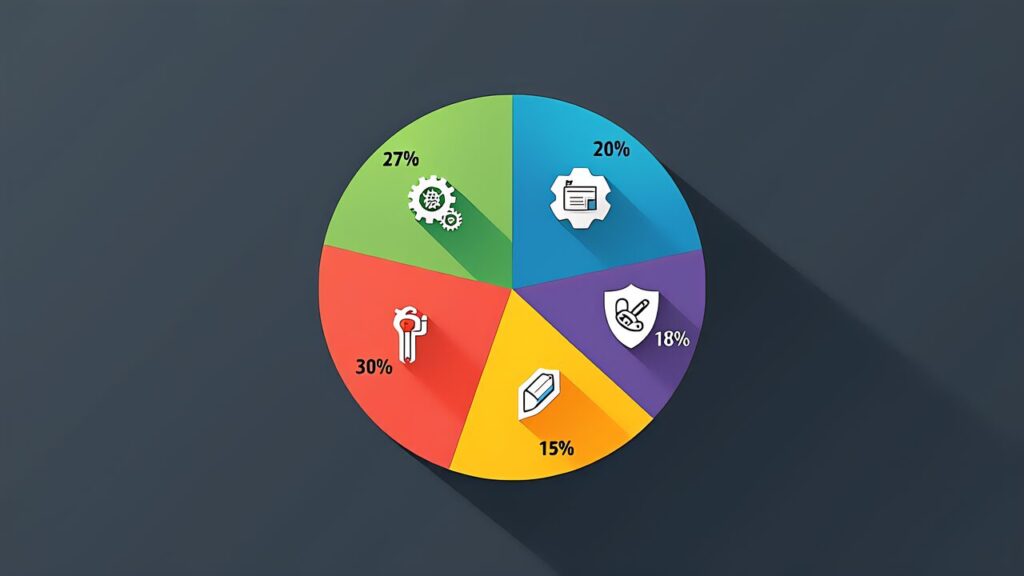
The CCA Foundations exam covers 5 domains with the following weightings. Moreover, understanding these weightings is crucial for time allocation in your study plan.
Domain 1: Agentic Architecture & Orchestration (27%) — The highest-weighted domain. Covers agent loop design, multi-agent orchestration, sub-agent spawning, multi-step workflows, Agent SDK hooks, state management, and task decomposition.
Domain 2: Tool Design & MCP Integration (18%) — Tool schema design, MCP server/client architecture, scoped access control, error handling, and tool result formatting.
Domain 3: Claude Code Configuration & Workflows (20%) — CLAUDE.md hierarchy design, slash commands, hooks, workflow optimization, and team configuration management.
Domain 4: Prompt Engineering & Structured Output (20%) — System prompt layering, few-shot example design, JSON Schema-based structured output, and prompt chaining.
Domain 5: Context Management & Reliability (15%) — Context window optimization, error recovery, confidence scoring, human review workflows, and source attribution.
Furthermore, the strategic implication is clear: D1 accounts for 27% of the total score — nearly double D5’s 15%. Consequently, prioritizing D1 in your study plan yields the highest return on investment.
The CCA Foundations exam presents questions within realistic enterprise deployment scenarios. Moreover, 4 of 6 scenarios are randomly selected for each exam session.
S1: Customer Service Automation — Multi-agent system design for handling customer inquiries. Additionally, covers intent routing, escalation workflows, and conversation state management. Primarily tests D1 and D2.
S2: Code Review Pipeline — Automated code analysis and review system. Furthermore, involves tool design for repository access, diff analysis, and structured feedback generation. Primarily tests D2 and D3.
S3: Research Assistant — Multi-step information gathering and synthesis system. Specifically, tests long-context management, source attribution, and multi-agent coordination. Primarily tests D1 and D5.
S4: Data Processing Pipeline — Batch processing system with structured output requirements. Moreover, covers pipeline orchestration, error handling, and output validation. Tests D1, D3, and D4.
S5: Content Generation System — Multi-format content creation with quality control. Additionally, involves prompt engineering, structured output, and human review workflows. Tests D3, D4, and D5.
S6: Enterprise Integration Platform — MCP-based integration with multiple enterprise systems. Furthermore, requires understanding of tool scoping, authentication, and multi-agent orchestration. Tests D1 and D2.
Since 4 scenarios are randomly selected from 6, the probability of any single scenario being excluded is 33% (2/6). Consequently, if you have one weak scenario, you can avoid it one in three times. However, having two or more weak areas makes avoidance difficult. Therefore, aim to be comfortable with all 6 scenarios.
Additionally, analyzing the correlation between scenarios and domains reveals that D1 is relevant to 4 out of 6 scenarios (S1, S3, S4, S6 partially). Similarly, D3 is relevant to 3 (S2, S4, S5). This naturally makes D1 the highest priority in your study plan.
The highest-scored domain consists of 7 task statements. Furthermore, mastering this domain provides the foundation for the entire exam.
Additionally, T1.1 Agent Loop Design covers stop_reason-based control, tool_use continuation vs end_turn termination, and adding tool results to conversation history. The anti-pattern of “parsing natural language signals to determine loop termination” is frequently tested.
Moreover, T1.2 Multi-Agent Orchestration covers hub-and-spoke architecture and coordinator-subagent communication design. The key point is that subagents operate in isolated contexts.
Furthermore, T1.3 Sub-Agent Spawning covers the Task tool, AgentDefinition, and fork_session. Understanding when to use parallel vs sequential spawning is essential.
T1.4 Multi-Step Workflows specifically addresses programmatic enforcement (hooks, precondition gates) vs prompt-based guidance. For deterministic compliance requirements, prompts alone are insufficient.
T1.5 Agent SDK Hooks covers PostToolUse hooks, tool call interception, and policy violation blocking. Additionally, understanding the hook execution order and timing is critical.
T1.6 State Management addresses conversation context persistence and session isolation. Moreover, the trade-offs between stateful and stateless designs are a common exam topic.
T1.7 Task Decomposition covers breaking complex requests into manageable sub-tasks. Furthermore, understanding granularity decisions and dependency analysis is key.
This domain covers 5 task statements. Additionally, T2.1 Tool Schema Design focuses on creating clear, unambiguous tool definitions that guide the model toward correct usage.
Furthermore, T2.2 MCP Architecture covers server implementation, client integration, and transport layer selection. T2.3 Scoped Access Control addresses permission boundaries for tools in multi-agent systems.
Moreover, T2.4 Error Handling covers graceful degradation, retry strategies, and error context propagation. T2.5 Tool Result Formatting ensures optimal response structures for downstream processing.
This domain covers 5 task statements focused on practical Claude Code usage. Additionally, T3.1 CLAUDE.md Hierarchy Design is central — understanding the layered configuration system (.claude/settings.json, project-level, user-level) is essential.
Furthermore, T3.2 Slash Commands and T3.3 Hooks cover customization points for extending Claude Code functionality. T3.4 Workflow Optimization addresses efficient task delegation and context management.
Moreover, T3.5 Team Configuration Management covers shared settings, permission models, and collaboration workflows in enterprise deployments.
This domain covers 6 task statements. Additionally, T4.1 System Prompt Layering addresses the design of multi-layer instruction hierarchies.
Furthermore, T4.2 Few-Shot Example Design covers effective example construction for guiding model behavior. T4.3 JSON Schema-Based Structured Output is critical — understanding schema design patterns and validation is frequently tested.
Moreover, T4.4 Prompt Chaining addresses multi-step reasoning workflows. T4.5 Output Validation covers automated quality checks. T4.6 Prompt Versioning addresses managing prompt iterations in production.
The lowest-weighted but still important domain covers 6 task statements. Additionally, T5.1 Context Window Optimization addresses efficient use of the available context.
Furthermore, T5.2 Error Recovery covers structured error context propagation in multi-agent systems. T5.3 Confidence Scoring addresses routing decisions based on model certainty.
Moreover, T5.4 Token Management covers efficient context window usage. T5.5 Human Review Workflows addresses confidence-based routing and stratified sampling. T5.6 Source Attribution covers claim-source mapping and contradiction detection.
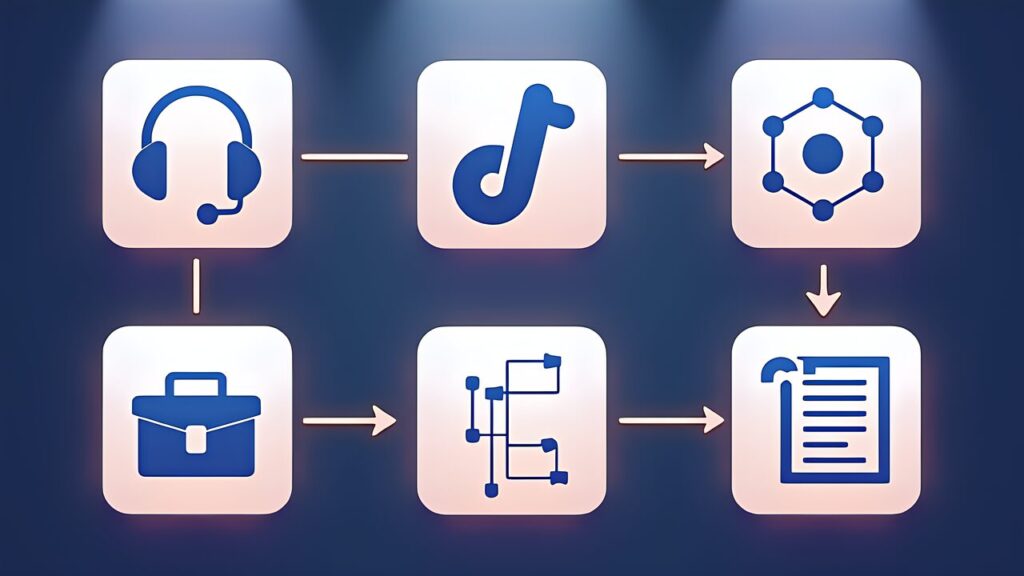
An often-overlooked aspect of the CCA Foundations exam is the interdependence between domains. Additionally, exam scenarios cross multiple domains, so studying domains in isolation is insufficient.
D1 and D2 Linkage: Agent loops (D1) operate through tools. Furthermore, if tool design (D2) is inadequate, agents cannot select the correct tools and loops break down.
D1 and D5 Linkage: Errors in multi-agent systems (D1) propagate as structured error contexts (D5). Moreover, understanding both D1 design and D5 reliability patterns is necessary for correct answers.
D3 and D4 Linkage: Rules in CLAUDE.md (D3) are essentially a form of system prompts (D4). Additionally, CLAUDE.md hierarchy design is a concrete implementation of D4’s prompt layering.
D4 and D5 Linkage: Structured output (D4) directly impacts context management efficiency (D5). Furthermore, structuring output with JSON Schema eliminates parsing overhead and conserves context window space.
Anthropic Academy offers 13 courses for free on Skilljar. Moreover, the following 4 courses are particularly important for CCA preparation.
Additionally, “Building with the Claude API” (8.1 hours) covers core API concepts. “Prompt Engineering” (4.2 hours) addresses D4 directly. Furthermore, “Tool Use and MCP” covers D2 essentials. “Agent Development” addresses D1 and D3 topics.
Phase 1 (2 weeks): Course completion. Complete the 4 Anthropic Academy courses. Total 16-20 hours. Furthermore, focus on hands-on exercises rather than passive watching.
Phase 2 (1 week): Deep dive with this series. Moreover, use this 7-part series to build the design pattern mental model for all 5 domains.
Phase 3 (1 week): Practice and review. Additionally, complete practice exams under timed conditions and review weak areas.
As of March 2026, CCA Foundations is the only practical certification proving “AI agent architecture design capability.” Furthermore, positioned like AWS Solutions Architect for cloud, CCA aims to become the standard for AI agent design.
CCA launched on March 12, 2026. Moreover, early certification provides scarcity value while the holder pool is small, first-mover credibility in a rapidly growing field, and foundation for the upcoming advanced certifications planned later in 2026.
Additionally, at $99 per attempt (or free for the first 5,000 partner employees), the cost-benefit ratio is exceptional compared to other enterprise certifications.
This article is Part 1 of the 7-part CCA Foundations exam preparation series. Furthermore, the remaining 6 parts will deep-dive into each domain.
Moreover, CCA Foundations tests “quality of design judgment” rather than “knowledge memorization.” This series explains each domain’s task statements with concrete code examples and architecture diagrams, aiming for understanding of “why design it this way.”