The Complete Guide to Creating 3D Print Models with Tripo AI [2026 Edition]
swiftwand swiftwand.ai
“Let’s start a side business with a 3D printer.” However, the first thing most people print after making that decision is a figurine they think looks “cool” — and that starting point is the most common entry to failure in AI 3D printing side businesses. In this market, where monthly earnings of $65–$650 are considered realistic, the reason most challengers end up in the red isn’t a lack of technical skill. It’s how they decide “what to make.”
This article dissects the typical failure patterns in 3D printing side businesses and explains a workflow for scientifically identifying “what sells” using AI-powered market analysis tools. The era of making and selling what you love is over. The era of winning with data has arrived.

The moment you get a 3D printer, you feel like a “creator.” However, to make it work as a side business, you need to be a marketer before being a creator. Why does starting with “what you want to make” lead to failure? Let’s break down the three structural causes.
Search “3D print” on Mercari (Japan’s largest flea market app), and you’ll find cookie cutters and phone stands crammed into the $2–$7 range. Even though filament costs about $20 per kg (~¥3,000) and material costs per item run $0.35–$1.35, once you factor in 2–4 hours of print time at an hourly rate, profit drops to nearly zero.
In other words, the core problem isn’t that “prices are low.” It’s that “there’s no differentiation.” Furthermore, products printed from STL files anyone can download become completely commoditized with other sellers’ offerings. Consequently, the more you sell, the more the market price drops — a classic race to the bottom.
Therefore, as long as you compete in this price range, you’ll never escape the state of “picking up spare change as an extension of your hobby.” At an hourly rate of $3.35 or less, it’s far more efficient to work a part-time job at a convenience store.
For example, consider those 50 phone stands you printed in bulk thinking “batch printing is more efficient.” The moment a new iPhone launches, the size changes and your entire inventory becomes worthless. This is the “invisible loss” that doesn’t appear in material cost calculations.
Smartphone-related accessories in particular are completely dependent on device model change cycles. In other words, this year’s bestseller won’t necessarily sell next year as-is. The more inventory you hold, the more this risk accumulates exponentially.
On the other hand, if you build a “made-to-order” business model, inventory risk drops to nearly zero. A system where you start printing only after receiving an order is the most rational approach for a side business.
Moreover, downloading a popular character model from Thingiverse, printing it, and listing it on a marketplace — this constitutes copyright infringement and carries the risk of legal action. Many beginners lack awareness that “personal use and commercial use have completely different rules.”
Additionally, in June 2025, Etsy updated its policy to require sellers to certify that listed items are original designs. Specifically, this means that simply printing someone else’s design and selling it could result in account suspension. Consequently, to build a sustainable side business, creating original designs is now an essential requirement, not an option.

The opposite of “make what you want” thinking is a “make what sells” approach. To execute this, you need AI-powered market analysis tools. Here, we introduce a three-step workflow using EverBee, eRank, and Claude to identify high-demand, low-competition niches.
EverBee is a Chrome extension that displays real-time sales data for Etsy listings. The free version provides basic data, while the Growth Plan ($29.99/month, or $19.99/month with annual billing, as of March 2026) unlocks full analytics features.
Specifically, when you search “3D printed” on EverBee, the following data is displayed in a list.
In other words, by surveying this data, you can instantly distinguish between “selling categories” and “saturated categories.” As of March 2026, high-demand categories include Articulated Animals, cosplay parts, home decorations, and tabletop RPG miniatures and dice towers.
However, high demand doesn’t necessarily mean you should enter. What matters is the “balance between demand and competition.” For example, even if a category has 1,000 monthly sales, if there are 5,000 sellers, it’s best to avoid it.
Furthermore, eRank is an SEO and market analysis tool specialized for Etsy. It’s available from a free plan, and the Pro Plan ($9.99/month, as of March 2026) unlocks full keyword analysis and rank tracking.
The true value of eRank lies in its “Keyword Explorer.” For instance, while “dice tower” has high monthly search volume and fierce competition, long-tail keywords like “magnetic dice tower” or “collapsible dice tower” have significantly fewer competitors. This is precisely where opportunity lies.
The key metric in eRank is the “Competition Score.” A keyword is considered a “gap” when its search volume is high but its competition score is low. In particular, focusing on keywords that combine 3D printing’s strengths — “custom,” “personalized,” and “made to order” — makes it easier to find gaps.
The final step is to input data from EverBee and eRank into Claude (Anthropic’s AI assistant) for cross-analysis. Specifically, export CSV data from both tools and ask Claude to generate a “High Demand × Low Competition” matrix.
Claude is particularly powerful at processing natural language, making it excellent at identifying “hidden patterns that aren’t visible in numerical data alone.” For example, it can simultaneously analyze seemingly different information and propose targeted strategies for specific communities.
Moreover, Claude’s advantage is that it enables “interactive analysis.” By conversing back and forth — “Narrow down further,” “Consider seasonal factors” — you can progressively sharpen your strategy, an approach that conventional BI tools cannot offer.

Specifically, based on market analysis results, the following four categories have been identified as “high-value niches” where 3D printing’s strengths shine. What they all share is “customizability that mass production cannot replicate” — which is 3D printing’s greatest competitive advantage.
1. Custom Nameplates and Door Signs ($20–$55)
For example, simply changing the design to match a customer’s name or font preference creates a “one-of-a-kind” product. Material costs run $0.65–$2, meaning profit margins of 200–500% are achievable.
Therefore, if you keep per-order work time under 30 minutes, the hourly rate calculation exceeds $33. This is the power of “high-value niches.”
Related article: OpenSCAD AI Parametric Design: Creating “Any Size” 3D Models with Code
2. Board Game Organizers ($13–$33)
Similarly, custom inserts and token organizing trays designed for specific board games have strong, persistent demand in the gaming community. Because each design is game-specific, competition naturally thins. Moreover, these products are rarely returned.
In particular, the tabletop RPG community has a culture of “investing generously in quality accessories,” and their low price sensitivity is a significant advantage.
3. Pet Products: Personalized Food Bowl Stands ($20–$40)
Food bowl stands engraved with a pet’s name directly appeal to pet owners’ emotions. Printing with PETG filament ensures both water resistance and food safety.
The pet market’s characteristic is that owners tend to “invest more in their dogs and cats than themselves.” Adding customization elements creates clear differentiation from mass-produced products.
4. Architectural and Interior Scale Models ($65–$200)
Creating scale models for architecture firms and interior designers is the highest-priced category in the B2B space. Precision modeling skills serve as a barrier to entry, making it resistant to price competition.
In this field, the Bambu Lab A1 mini (~$200–$325) provides a significant advantage with its high-precision printing capabilities. With 500mm/s high-speed printing and automatic calibration, you can achieve both shorter delivery times and consistent quality.

The most valuable aspect of market analysis isn’t chasing what’s selling now. It’s the ability to anticipate what will sell next. By leveraging AI tools, you can grasp seasonality and trend waves as numerical data and work backward to calculate the optimal timing for preparation.
Looking at Google Trends search trends for “3D printed gift,” search volume spikes sharply from November to December. However, starting to prepare products at that time is already too late. Etsy’s search algorithm favors established listings, so products need to be published at least 2–3 months before the peak season.
Therefore, the ideal workflow is: “Identify Christmas trends in September → Develop prototypes in October → Begin listings in November → Capture peak demand in December.” AI tools make it possible to quantitatively design this reverse-engineering process.
By inputting EverBee’s sales data and Google Trends data into Claude simultaneously, you can have it analyze correlations that manual analysis would miss. For example, Claude can detect seasonal demand patterns and propose optimal product launch timing as recommendations.
Furthermore, Claude can detect emerging trends from social media and news data. Specifically, if a specific 3D print design goes viral on TikTok, related products can see a sales surge within 1–2 weeks. Leveraging AI to capture such “micro-trends” can create a decisive competitive advantage.

Many 3D printing side business beginners calculate profit as “selling price minus material cost.” However, this calculation is fatally flawed. True profit becomes visible only when you include labor costs, equipment depreciation, platform fees, and shipping.
| Platform | Characteristics | Recommended Products | Fees |
|---|---|---|---|
| Etsy | Global market, design-focused. Original designs required since June 2025 | Art, home decor, gifts | $0.20/listing + 6.5% sales |
| minne | Japan-focused handmade marketplace, Japanese-style and natural designs popular | Accessories, household goods, interior items | 10.56% sales |
| Mercari | High immediacy but fierce price competition | Practical items, gadget accessories, seasonal | 10% sales |
| Shopify | Ideal for brand building and custom orders | High-value items, B2B, made-to-order | From $39/month + payment fees |
Specifically, each platform has different user demographics and purchasing behaviors. Etsy users value “design and story,” while Mercari users prioritize “price and immediacy.” Therefore, the optimal product lineup differs for each platform. In particular, for Etsy, adding a “behind-the-scenes story of the creation process” can significantly boost conversion rates.
| Item | Amount |
|---|---|
| Material (PLA 50g × ~$20/kg) | ~$1.00 |
| Electricity (3-hour print, 0.2kW × $0.18/kWh × 3h) | ~$0.11 |
| Printer depreciation (A1 mini ~$325 / 2 years / 365 days) | ~$0.45/day |
| Failure loss (10% estimate) | ~$0.16 |
| Packaging (box + cushioning) | ~$0.65 |
| Shipping | ~$1.40 |
| Mercari fee (10%) | ~$2.70 |
| Total cost (excluding labor) | ~$6.47 |
| Gross profit (excluding labor) | ~$20.53 |
A gross profit of ~$20.53 may look sufficient at first glance. However, if the design, printing, post-processing, photography, listing, and shipping workflow took 1.5 hours, the labor cost at minimum wage (~$10/hour) would be ~$15, reducing the actual profit to approximately $5.50.
On the other hand, if you can streamline the workflow to 25 minutes using AI tools and parametric design, the labor cost drops to ~$2.50, resulting in an actual profit of approximately $18. In other words, “workflow efficiency” directly translates to profitability.
These three steps — “market research → cost calculation → workflow optimization” — should become routine. Re-running market analysis on a weekly basis and adjusting your product lineup is key. AI tools ensure this cycle runs at minimal cost and maximum speed.
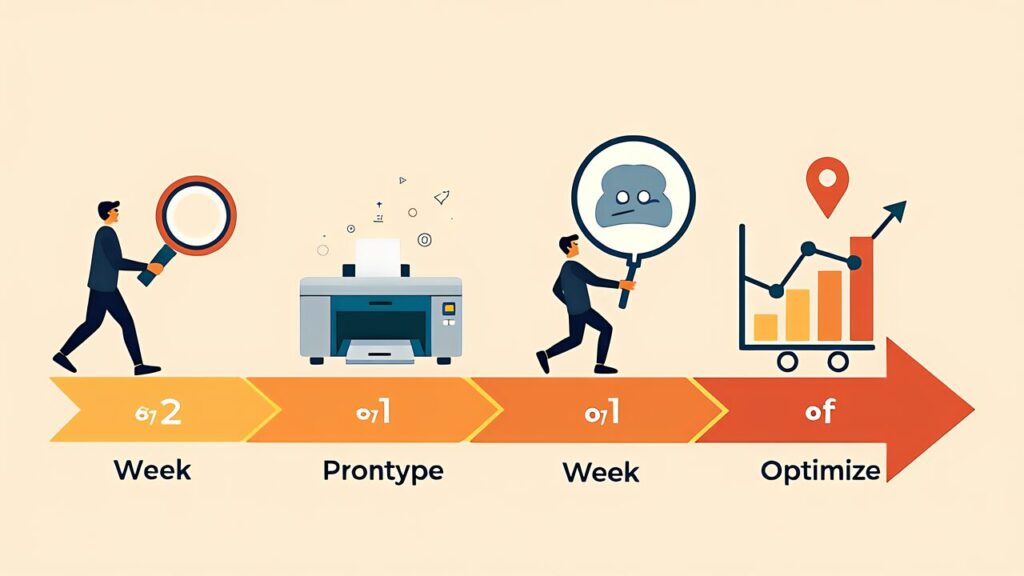
Theory alone won’t start a side business. Below is a practical roadmap for anyone with a 3D printer to generate their first sale within 30 days in an AI 3D printing side business.
During this first week, do not print anything at all. In other words, focus exclusively on gathering data, analyzing it, and identifying markets you can win in.
Specifically, if views are low, review your keywords. If views are high but sales are low, review your price and photos. The important thing is to “measure, analyze, and improve” — not to “wait and hope.”
After 30 days, your “data-driven side business” foundation is complete. From here, the cycle of repeating this process and continuously improving with AI support is the path from side business to full business.
The reason 90% of AI 3D printing side businesses fail is simple: they start by asking “What do I want to make?” instead of “What does the market want?” Reversing this question is the first step to success.
With market analysis tools like EverBee and eRank, plus AI analysis by Claude, “market insight” — once available only to professional marketers — is now accessible to individuals. Furthermore, by combining 3D printing’s unique advantage of “customization at low cost” with data-driven niche targeting, profit margins of 200–500% are achievable.
Moreover, don’t wait for perfection. Launch your MVP within 30 days, collect real data, and improve from there. That’s the path to a sustainable 3D printing side business.
However, the prerequisite for all of this is having the right equipment. If you haven’t chosen your first 3D printer yet, check out our buyer’s guide: 3D Printer Buyer’s Guide 2026: Choosing Your First Machine with AI Scoring.