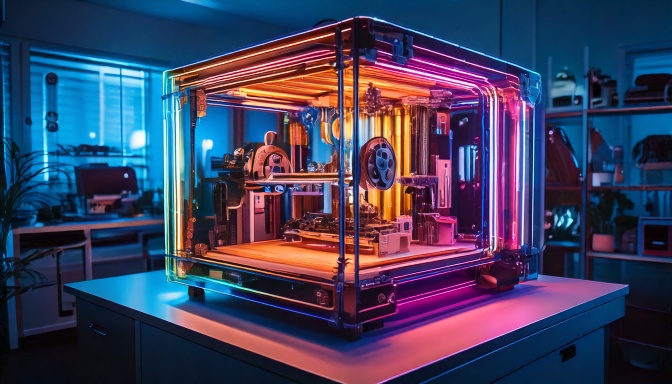
Bambu Lab 3D Printer Complete Guide: High-Speed Multi-Color Printing for Beginners (2026)
swiftwand swiftwand.ai
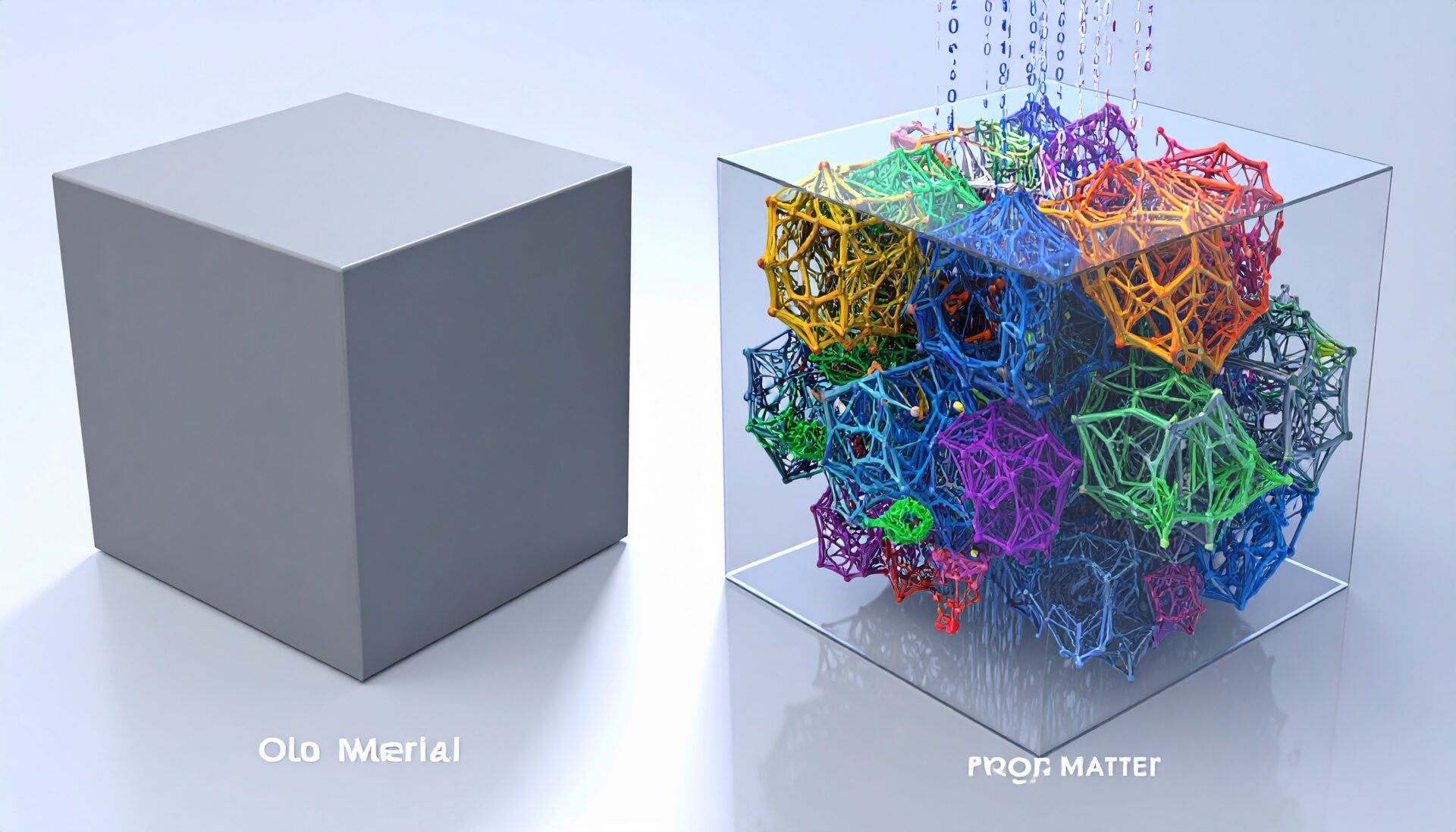
“Metal springs.” “Rubber gaskets.” “Plastic hinges.” Until 2025, these were things you bought at the hardware store. But in 2026, these are things you print on your home FDM printer. And not by merely copying their shape — by embedding their very function as geometric structure.
Welcome to the world of Computational Metamaterials. The “hardness” or “elasticity” of a material no longer depends on the material itself. It has become a programmable variable defined by structure.
In this article, we thoroughly explore the frontiers of material programming that every maker should know — from achieving both “steel-like rigidity” and “sponge-like softness” simultaneously with a single TPU filament, to Auxetic structures that absorb and neutralize external impacts.
Why can ordinary plastic replace metal springs? The secret lies in microstructure design. Traditional CAD creates macro shapes like blocks and cylinders. But metamaterial design tools (nTop, Blender Geometry Nodes) computationally generate the micro-lattice structures within.
Consider printing a shoe insole. The heel area needs high density to absorb landing impacts, while the arch needs low density for cushioning. Instead of laminating multiple materials, you achieve this as a continuous gradient within a single TPU (thermoplastic polyurethane) part. You are not changing slicer settings — the geometry of the model itself determines its physical properties.
Imagine ordinary rubber. When you stretch it, it gets thinner in the middle, right? (Positive Poisson’s ratio.) Auxetic structures are different. When you pull them, they get wider. Conversely, when you push them, the material gathers and becomes harder.
This property is unbeatable for shock absorption. The instant you drop your phone, instead of the surrounding material fleeing from the impact point, it rushes toward it. Local density spikes instantly, functioning as a protector. While countless Auxetic Case models already exist on Thingiverse and Printables, the 2026 trend is generatively creating these lattice structures matched to your own phone’s 3D scan data.
When you hear “mechanism,” you think of assemblies of screws, gears, pins, and bearings. But a Compliant Mechanism is different. It is a single-part machine that moves by leveraging deformation.
Pliers printed on an FDM printer, ready to use right off the build plate. Instead of a pivot hinge, they open and close using the flex of a thinly designed polymer section. Zero friction, no lubrication needed, maintenance-free. Best of all, zero post-print assembly required (print-in-place). The furniture industry is also researching snap-fit applications that lock using only printed resin elasticity, without screws. Assembly-free furniture may soon become the norm.
Metamaterials can also hold “memory.” A bistable mechanism is a structure that snaps into a different shape once a threshold is exceeded and holds that state — like a hairpin or light switch.
Applied creatively, you can build mechanical memory that stores “state” without electricity. For example, a medicine cap: when opened, an internal bistable latch snaps and the word “OPENED” physically emerges. Once opened, the shape change is irreversible — perfect for tamper-evidence. No sensors, no batteries. Just geometry.
Such structural design was once the exclusive domain of aerospace (nTopology, etc.), with annual licenses costing thousands of dollars. But in 2026, things have changed. The power of open source.
Blender, the 3D CG software, is now the most powerful metamaterial design tool. Using add-ons like Sverchok and Tissue, you can generate lattice structures (TPMS: Triply Periodic Minimal Surfaces) mathematically and export them as STL.
Orca Slicer 3.0+ comes with a standard Lattice Modifier. Load a solid block, select “Lattice (anisotropic lattice)” as the infill type — surpassing Gyroid — and anyone can create basic metamaterials.
We are no longer bound by the specs (tensile strength, flexural modulus) provided by material manufacturers. Even using the same PLA “material,” the “structure” you design determines whether it behaves like rubber or like metal.
“What filament should I use?” That question is outdated. “What geometry should I run?” That is the question of 2026.
Throw away your off-the-shelf springs. Your printer can rewrite the very laws of physics governing matter.
For more information, visit All3DP.