Anthropic Academy Complete Guide 2026 — Master Claude with 15 Free Courses
swiftwand swiftwand.ai
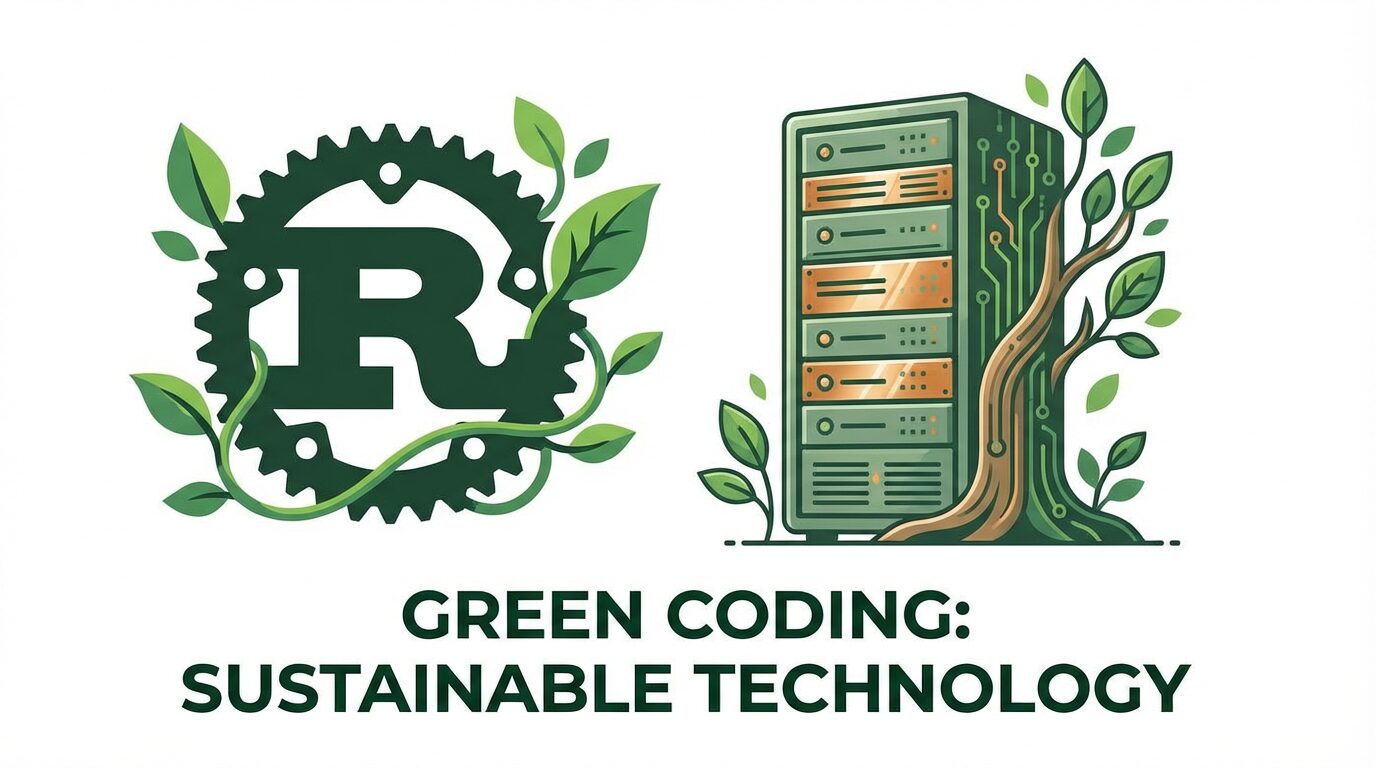
In 2026, the biggest theme in cloud-native development isn’t “speed”—it’s efficiency. As data center power consumption becomes a global challenge, software engineers face a new responsibility: Green Coding.
This article explains why Rust has evolved beyond “just a safe language” into an economic and environmental imperative—with hands-on implementation using the latest Axum framework.
Here’s an inconvenient truth: “Python is easy to write, but not kind to the planet.” Research has shown that Rust is roughly 30× more energy-efficient than Python and about 1.5× more efficient than Go.
In 2026 Cloud FinOps, this translates directly to cost savings. On serverless platforms like AWS Lambda and Cloud Run, billing is based on “execution time × memory usage.” With no garbage collection pauses and a minimal footprint, Rust literally generates money through code.
The Rust web framework war has a clear winner in 2026: Axum. While Actix-web still leads some benchmarks, Axum wins on what matters:
Axum’s beauty lies in its simple dependency injection. No global variables needed—pass DB pools and other dependencies to handlers thread-safely via the State pattern:
use axum::{
    extract::State,
    routing::{get, post},
    Json, Router,
};
use serde::{Deserialize, Serialize};
use std::sync::Arc;
use tokio::net::TcpListener;

// 1. Application state (DB pool, etc.)
struct AppState {
    db_pool: sqlx::PgPool,
}

#[derive(Serialize)]
struct User {
    id: i32,
    username: String,
}

#[derive(Deserialize)]
struct CreateUser {
    username: String,
}

// 2. Handler function
// State> receives state. Order doesn't matter (Type Safe)
async fn create_user(
    State(state): State>,
    Json(payload): Json,
) -> Json {
    Json(User {
        id: 1,
        username: payload.username,
    })
}

#[tokio::main]
async fn main() {
    let shared_state = Arc::new(AppState { /* db_pool: pool */ });

    // 3. Routing
    let app = Router::new()
        .route("/users", post(create_user))
        .with_state(shared_state);

    let listener = TcpListener::bind("0.0.0.0:3000").await.unwrap();
    println!("Listening on port 3000");
    axum::serve(listener, app).await.unwrap();
}
This code guarantees type safety at compile time. No more “run it to find out if DI is broken”—the fear common in Go and Python disappears entirely.
Rust’s biggest payoff appears in production. The “stop-the-world” garbage collection pauses unavoidable in Go and Java simply don’t exist in Rust. This makes P99 latency remarkably stable. For financial trading, real-time bidding, and any system where millisecond spikes are fatal, Rust is the only viable choice.
Why Rust is “Green” compared to managed languages: Rust processes requests with zero-cost abstractions and manual memory management, delivering fast and predictable responses. Managed languages (Go/Java) must periodically pause for garbage collection, causing variable latency spikes. This difference compounds at scale—more predictable performance means fewer over-provisioned instances and lower cloud bills.
1. Cloud Cost Optimization Consulting
Help enterprises replace Go/Python microservices with Rust. AWS Lambda execution time can drop 50–80%, and quantifying cost savings justifies premium consulting rates.
2. OSS Contributions → Career Growth
Submit PRs to Tokio, Axum, SQLx, and other Rust ecosystem projects to build global visibility. Rust engineer demand far exceeds supply, and average compensation trends higher than other languages.
3. Technical Content & Courses
Rust’s steep learning curve creates high demand for practical tutorials and hands-on courses. Paid content on platforms like Udemy can generate meaningful side income.
4. Sustainability Reporting Services
As ESG reporting becomes mandatory, help companies quantify CO2 reduction from Green Coding adoption. Provide measurable impact data for sustainability reports.
For experienced programmers: 2–4 weeks for basic syntax, plus 1–2 months to internalize the ownership system. Fighting the compiler is stressful at first, but runtime errors drop dramatically in return.
Axum is officially developed by the Tokio team with the deepest Tokio ecosystem integration. Actix Web has a longer history and raw benchmark performance, but Axum’s adoption rate is growing rapidly. For new projects in 2026, Axum is recommended.
Use AWS Carbon Footprint Tool or open-source power measurement tools like Scaphandre. Run identical workloads before and after migration, comparing execution time, memory usage, and power consumption.
No. Start by selecting one bottleneck microservice, rewrite it in Rust, and measure the impact. Rewriting everything at once is high-risk. Incremental migration is recommended.
A Rust-native deployment platform. No Dockerfiles or config files needed—deploy using code annotations alone, including database and secrets management. Ideal for personal projects and prototypes.
Rust adoption is growing in inference engines and data pipelines. ML frameworks like Hugging Face’s Candle and Burn have emerged, excelling in edge inference and high-throughput scenarios.
Migrating an entire codebase from Python or Node.js to Rust overnight is neither practical nor advisable. The most successful teams adopt a gradual strangler pattern, replacing high-traffic or resource-intensive microservices first. Start by profiling your existing infrastructure to identify the services with the highest CPU and memory consumption. These are your best candidates for Rust rewrites because they offer the largest environmental and cost impact per engineering hour invested.
A practical migration timeline looks like this: spend the first month building a small internal tool or CLI utility in Rust to build team familiarity. In months two and three, rewrite one non-critical microservice and run it alongside the original for comparison. Measure the difference in resource consumption, latency, and error rates. Most teams see a 50-70% reduction in compute costs for equivalent workloads. Use these concrete numbers to build the business case for broader adoption. By month six, your team should have enough Rust expertise to tackle mission-critical services with confidence.
In 2026, learning Rust isn’t “tackling a hard language”—it’s investing in responsible engineering. The initial learning cost is more than recovered through operational cost savings and CO2 reduction.
Start by rewriting one small microservice in Axum. That’s your first step toward a greener, more efficient future.
For more information, visit All3DP.