Claude Code Getting Started 2026 — AI Pair Programming with Claude Code in Action
swiftwand swiftwand.ai
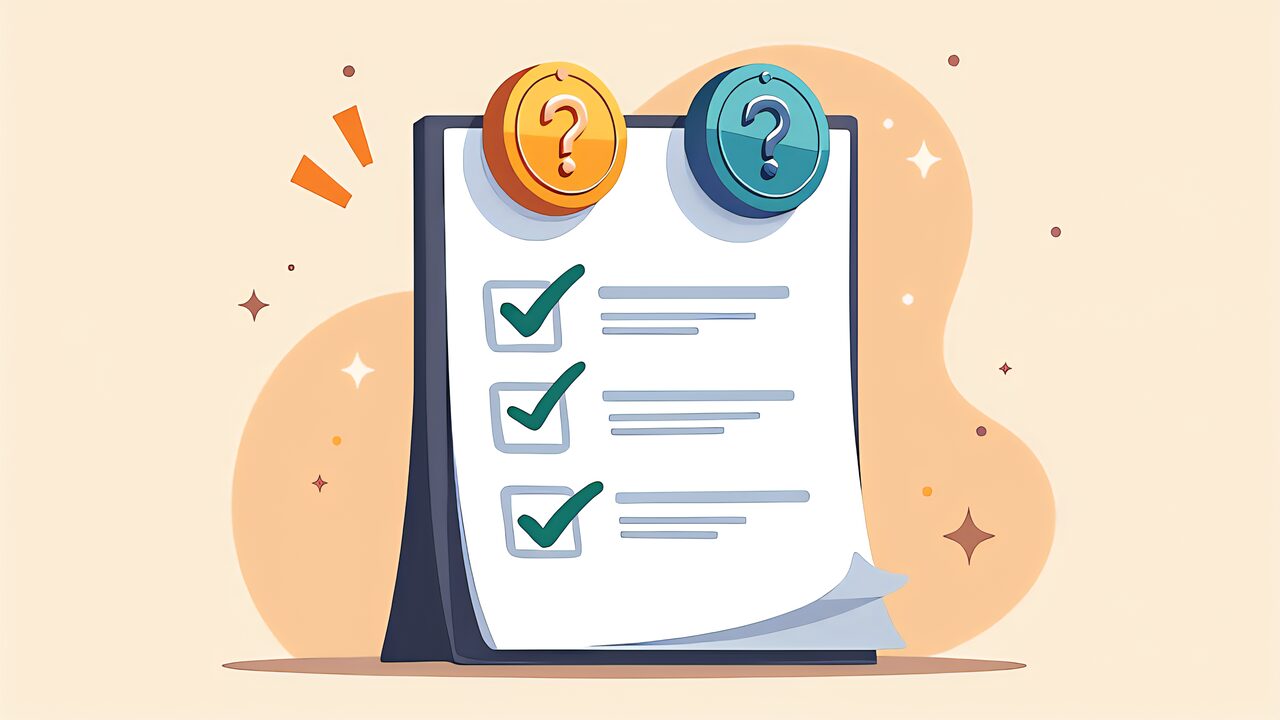
Practice questions are what turn memorized facts into points on exam day. This set offers 30 original questions drawn proportionally from the two Google Cloud foundational exams — Cloud Digital Leader (CDL) and Generative AI Leader. Every item follows the official exam-guide topics, and every option is built only from real Google Cloud and AWS services and concepts. No actual exam questions are reproduced here.
This article contains affiliate links. As an Amazon Associate, we earn from qualifying purchases.
Google does not publish a passing score, but a practical target is roughly 80% correct. Take all 30 questions without looking at the answers, then score yourself by domain. Any domain under 80% is a weak spot: read the explanation, then return to the matching study guide. Three habits help — reason backward from requirement words (“global consistency”, “search across company data”, “no specialists on staff”), distinguish similarly named products by intended user and scenario, and confirm you can state the “why” of each answer in one sentence. The first 15 questions are Cloud Digital Leader; the last 15 are Generative AI Leader. Pace yourself at about 90 seconds per question to match the real 90-minute, 50-60-question format.
Q1. A team wants to run an existing application unchanged and needs OS-level control. Which model fits? (A) IaaS (B) PaaS (C) SaaS (D) FaaS
Q2. Under the shared responsibility model on IaaS, who patches the guest operating system? (A) Google (B) The customer (C) Nobody (D) The hardware vendor
Q3. A workload needs a globally distributed relational database with strong consistency. Which product? (A) Cloud SQL (B) Cloud Spanner (C) Firestore (D) Bigtable
Q4. Which service is a serverless data warehouse for large-scale analytics? (A) Cloud Storage (B) Cloud SQL (C) BigQuery (D) Bigtable
Q5. A company wants image labeling without any ML expertise. Best choice? (A) Train a custom model on the AI platform (B) A pre-trained Vision API (C) BigQuery ML (D) Compute Engine with a GPU
Q6. Which storage class suits data accessed less than once a year? (A) Standard (B) Nearline (C) Coldline (D) Archive
Q7. A microservices app needs portability and scalable container orchestration. Which? (A) Compute Engine (B) Google Kubernetes Engine (C) Cloud SQL (D) App Engine standard only
Q8. Which service protects web applications against DDoS attacks? (A) Cloud IAM (B) Google Cloud Armor (C) Cloud CDN (D) Cloud NAT
Q9. The principle of least privilege is implemented primarily through which service? (A) Cloud Armor (B) Cloud IAM (C) Cloud Storage (D) Cloud DNS
Q10. Which best describes encryption “at rest”? (A) Data moving over the network (B) Data stored on disk (C) Data displayed on screen (D) Data in CPU registers
Q11. An event-driven task should run with minimal operational overhead. Which? (A) Compute Engine VM (B) Cloud Functions (C) A dedicated GKE cluster (D) Bare metal
Q12. Which tool keeps cloud spend visible with thresholds and alerts? (A) Cloud Billing Reports and budgets (B) Cloud Armor (C) Cloud IAM (D) Cloud Spanner
Q13. In the 6R migration framework, moving a workload as-is to the cloud is called? (A) Refactor (B) Replatform (C) Rehost (D) Retire
Q14. A retailer needs fast, scalable storage for high-volume IoT time-series data. Which? (A) Firestore (B) Cloud Bigtable (C) Cloud SQL (D) Cloud Storage
Q15. Which Google practice emphasizes reliability through measurement and operations culture? (A) Site reliability engineering (B) Waterfall delivery (C) Manual change control (D) Single-region design
Getting consistent output is less about clever wording than about treating prompts as something you engineer and test.
Q1 A — IaaS rents infrastructure and keeps OS-level control. Q2 B — on IaaS the customer manages the OS and above. Q3 B — Cloud Spanner is the globally distributed, strongly consistent relational database. Q4 C — BigQuery is the serverless data warehouse. Q5 B — a pre-trained Vision API needs no ML expertise. Q6 D — Archive is for the least frequent access. Q7 B — GKE provides portable, scalable container orchestration. Q8 B — Google Cloud Armor handles DDoS and web protection. Q9 B — Cloud IAM enforces least privilege. Q10 B — at rest means stored on disk. Q11 B — Cloud Functions minimizes operational overhead for event-driven work. Q12 A — Billing Reports and budgets keep spend visible. Q13 C — rehost is the lift-and-shift “as-is” move. Q14 B — Bigtable suits high-volume time-series and IoT. Q15 A — site reliability engineering centers reliability on measurement and operations.
Q16. Which best defines a foundation model? (A) A rules engine (B) A large model pre-trained on broad data and adaptable to many tasks (C) A spreadsheet macro (D) A single-purpose classifier
Q17. What is Google’s family of foundation models called? (A) Titan (B) Gemini (C) Llama (D) Claude
Q18. An individual wants a conversational assistant they can customize with Gems. Which? (A) Gemini Enterprise (B) Gemini app / Gemini Advanced (C) Cloud SQL (D) Compute Engine
Q19. A company needs custom agents that search across internal data. Which fits best? (A) Gemini for Workspace (B) Gemini Enterprise (C) A pre-trained Vision API (D) Cloud Storage
Q20. Which technique gives a model correct, current evidence to cite? (A) Increasing temperature (B) Grounding / RAG (C) Few-shot only (D) Lowering top-p
Q21. Providing several examples in the prompt is called? (A) Zero-shot (B) Few-shot (C) Fine-tuning (D) Grounding
Q22. Which parameter most directly controls randomness of output? (A) Temperature (B) Region (C) Replica count (D) Storage class
Q23. A model confidently states a false fact. This is called? (A) Grounding (B) Hallucination (C) Fine-tuning (D) Tokenization
Q24. When a problem is missing private or up-to-date facts, the most cost-effective fix is usually? (A) Train a new model from scratch (B) Grounding / RAG (C) Raising temperature (D) Switching regions
Q25. What does the chain-of-thought technique encourage? (A) Shorter answers (B) Step-by-step reasoning (C) Random sampling (D) Lower cost only
Q26. Which Google framework guides securing AI systems? (A) SAIF (Secure AI Framework) (B) The 6R framework (C) The CAP theorem (D) The shared responsibility model only
Q27. Which is a core responsible-AI characteristic? (A) Maximum throughput (B) Transparency and fairness (C) Lowest price (D) Single-vendor lock-in
Q28. Gemini built directly into docs, sheets, and email is delivered as? (A) Gemini Enterprise (B) Gemini for Google Workspace (C) Model Garden (D) Cloud Functions
Q29. Which best maps to Amazon Bedrock’s role on Google Cloud? (A) BigQuery (B) Gemini Enterprise Agent Platform / Model Garden (C) Cloud Armor (D) Cloud SQL
Q30. Before deploying a gen-AI solution, the strongest business justification is? (A) It uses the newest model (B) A clear, measurable business value and managed risk (C) It is the cheapest option (D) It impresses executives
If you are building on top of these models rather than just using them, foundation-model engineering is the reference that covers the whole path from prototype to production.

 ポチップ
ポチップQ16 B — a foundation model is broadly pre-trained and adaptable. Q17 B — Gemini is Google’s foundation-model family. Q18 B — the Gemini app / Advanced is the customizable individual assistant. Q19 B — Gemini Enterprise builds custom agents over internal data. Q20 B — grounding and RAG supply real evidence. Q21 B — supplying examples is few-shot prompting. Q22 A — temperature controls randomness. Q23 B — a confident falsehood is a hallucination. Q24 B — grounding/RAG fixes missing facts more cheaply than retraining. Q25 B — chain-of-thought elicits step-by-step reasoning. Q26 A — SAIF guides securing AI systems. Q27 B — transparency and fairness are responsible-AI characteristics. Q28 B — Gemini for Workspace lives inside the productivity apps. Q29 B — the Gemini Enterprise Agent Platform / Model Garden mirrors Bedrock. Q30 B — measurable business value with managed risk is the strongest case.
Tally your score by domain. Below 80% in any area, go back to the matching study guide and rework the concept, not just the question. The two exams overlap on cloud and AI fundamentals, so progress in one lifts the other.
Three pairs cause most mistakes: Spanner versus Cloud SQL (global strong consistency versus single-region relational), grounding versus fine-tuning (add evidence versus retrain), and the three Gemini products by audience (individual, enterprise platform, in-Workspace). Resolve these and your accuracy jumps.
Used as a diagnostic rather than a quiz, these 30 questions reveal exactly where to spend your last study hours before sitting Cloud Digital Leader and Generative AI Leader. Reason from requirement words, separate look-alike products, and state the why — then book the exams.
Google Cloud official exam guides for Cloud Digital Leader and Generative AI Leader, and Google Cloud Skills Boost learning paths. All questions are original and contain no actual exam content.