Resin Material Guide 2026 — Water Washable, ABS-Like, Clear & Flexible Resins
swiftwand
Resin Material Guide 2026 — The Science Behind Purpose-Specific Resins: “Water-Washable,” “ABS-Like,” and “Clear”
Once you acquire a resin 3D printer, the next challenge you face is the question: “Which resin should I use?” Standard resin, water-washable resin, ABS-like resin, tough resin, flexible resin, clear resin, and high-temperature resin. With varieties increasing year after year, selecting the optimal material without knowledge of resin materials in 2026 is difficult. This article provides a scientific explanation of the physical properties and chemical characteristics of each resin type, covering everything from manufacturer-specific features to safe handling practices.
This article contains affiliate links. As an Amazon Associate, we earn from qualifying purchases.
Standard Resin — The Benchmark Material for All Resin Types
Understanding resin material selection in 2026 begins with understanding standard resin. Standard Resin is the most basic UV resin, composed primarily of photocurable acrylate-based monomers and photoinitiators (light-initiating agents).
When UV light (typically 365-405 nm wavelength) is applied to standard resin, the photoinitiators decompose and generate free radicals, triggering a chain reaction known as photopolymerization. In this reaction, C=C double bonds in the acrylate monomers break and form cross-linked polymer networks. This is why standard resin cures so quickly and produces parts with relatively high rigidity and good detail resolution.
Physical Properties of Standard Resin
Standard resin exhibits the following material characteristics:
Dimensional Stability: ±0.1-0.15 mm per 10 cm (good accuracy for detailed models)
Cost: ¥2,000-3,000 per liter (~$13-20) (most affordable resin type)
These properties make standard resin ideal for decorative models, miniatures, and jewelry prototypes where fine detail and surface finish are priorities. However, due to its brittleness, it is not suitable for functional parts that require flexibility or impact resistance.
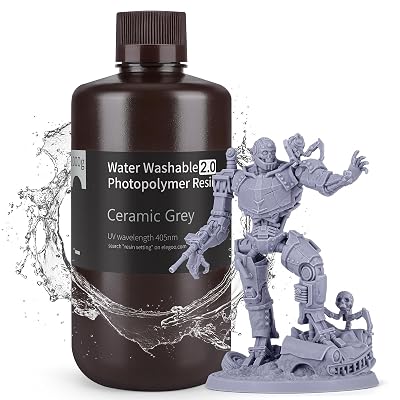
An example of a grey standard resin, a sensible first bottle.
Water-Washable Resin — The Eco-Friendly Alternative
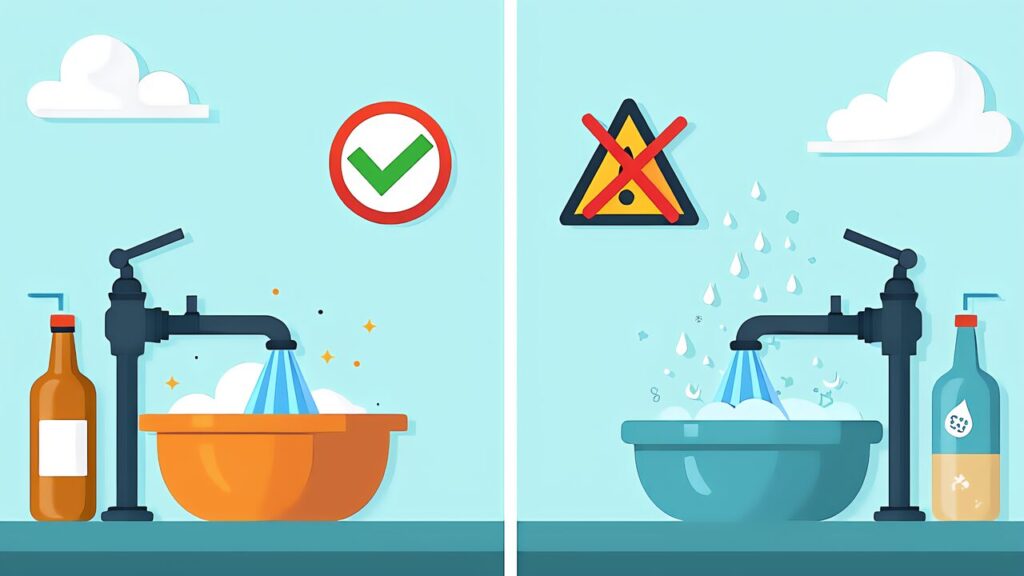
Water-washable resin represents a major breakthrough in resin 3D printing safety and sustainability. Unlike standard resin, which requires isopropyl alcohol (IPA) for post-processing, water-washable resin can be rinsed and cleaned with plain water. This significantly reduces solvent waste and improves working safety in home and small studio environments.
Chemical Mechanism: Why Water Works
Water-washable resins are formulated with hydrophilic (water-loving) groups added to the acrylate polymer structure. These polar groups allow the uncured resin monomer layer (which coats the surface after printing) to mix with water molecules. The hydrophilic coating acts as a surfactant, allowing water molecules to penetrate and dissolve the unreacted resin, carrying it away during the wash cycle.
The key chemical difference is the inclusion of polyethylene glycol (PEG) side chains or similar hydrophilic additives in the formulation. These chains make the resin “water-soluble” in its uncured state, but once photopolymerized (hardened), the cured resin becomes water-resistant due to the tightly cross-linked polymer network.
Physical Properties of Water-Washable Resin
Tensile Strength: 35-50 MPa (slightly lower than standard due to additive loading)
Elongation at Break: 2-4% (similar brittleness)
Hardness: Shore D 78-82 (slightly softer surface)
Print Resolution: ±0.1-0.2 mm (marginally less sharp detail due to hydrophilic coating)
Cost: ¥2,500-3,500 per liter (~$17-23) (10-20% premium over standard)
ABS-like resin mimics the mechanical properties of injection-molded ABS plastic, one of the most durable and impact-resistant engineering polymers. Unlike standard resin’s brittle nature, ABS-like resin offers superior toughness and flexibility, making it ideal for functional prototypes, mechanical assemblies, and wear-resistant components.
Chemical Formulation: Adding Toughness
ABS-like resins are engineered with elastomeric additives and specialized acrylate monomers that create a semi-flexible polymer matrix. The formulation typically includes:
Clear (Transparent) Resin — Optical Precision for Complex Designs
Clear resin enables transparent or translucent parts, opening possibilities for optical components, jewelry, lighting fixtures, and artistic displays. The challenge with clear resin lies in preventing light scattering within the printed part.
How Clear Resin Achieves Transparency
Transparency in resin is achieved through three key factors:
Monomer Selection: Using aliphatic acrylates with high light transmission properties (>90% in the visible spectrum).
Photoinitiator Choice: Selecting initiators that don’t create color during photopolymerization (clear resins use special UV-absorbers that become colorless post-cure).
Purity and Additives: Minimal filler loading and specialized anti-yellowing additives to maintain clarity over time and UV exposure.
The resin itself is already transparent, but post-print surface finish (layer lines, cure artifacts) can scatter light and reduce clarity. Mirror-smooth surface finishes are critical for optical applications.
Physical Properties of Clear Resin
Light Transmission: 85-92% in visible spectrum (similar to acrylic plastic)
Tensile Strength: 40-55 MPa (standard-like)
Elongation at Break: 3-6% (moderate flexibility)
Hardness: Shore D 80-83 (very hard, glass-like)
Refractive Index: ~1.52-1.56 (comparable to common acrylic)
Cost: ¥3,500-5,000 per liter (~$23-33) (premium for optical clarity)
Popular Clear Resin Brands
Formlabs Clear Resin: ¥4,800-5,200/L (~$32-35). Industry standard for optical prototypes and jewelry.
Flexible Resin — Rubber-Like Properties for Dynamic Applications
Flexible resin produces rubber-like or silicone-like parts that can stretch, compress, and bend without permanent deformation. This material is essential for seals, gaskets, phone cases, and artistic sculptures that require elasticity.
Elastomer Chemistry: Creating Flexibility
Flexible resins are formulated with long-chain polyurethane or polyol-based acrylates that prioritize molecular flexibility over rigidity. The polymer backbone has longer segments between cross-links, allowing the material to deform elastically and return to its original shape.
Key additives include:
Polyol Monomers: Long-chain molecules that provide flexibility.
Plasticizers: Small molecules that reduce friction between polymer chains, enabling stretching.
Cross-linkers: Minimized cross-linking density to allow molecular movement (unlike rigid resins with high cross-link density).
Physical Properties of Flexible Resin
Tensile Strength: 15-25 MPa (much lower than rigid resins, designed for stretch)
Elongation at Break: 100-250% (stretches significantly like rubber)
Hardness: Shore A 50-80 (soft, rubber-like)
Tear Resistance: Good resistance to tearing, similar to silicone
Recovery: Excellent elastic recovery (returns to shape after stretch)
Cost: ¥3,000-4,500 per liter (~$20-30) (premium for specialized properties)
Popular Flexible Resin Brands
Formlabs Flexible 80A: ¥4,200-4,800/L (~$28-32). Industry-leading flexible resin with 80 Shore A hardness.
Anycubic Flexible: ¥2,800-3,500/L (~$19-23). Budget-friendly option, 60-80 Shore A range.
Phrozen Flexible: ¥3,200-3,800/L (~$21-25). Fast-curing flexible for production.
High-Temperature Resin — For Heat-Resistant Applications
High-temperature resin withstands sustained heat exposure (100-150°C+) without deforming or losing mechanical properties. This makes it ideal for automotive components, industrial fixtures, and prototypes that must function in high-heat environments.
Thermally Stable Polymer Design
High-temperature resins are engineered with aromatic acrylates and cycloaliphatic monomers that have higher glass transition temperatures (Tg). Tg is the temperature at which the polymer transitions from rigid to rubbery—keeping Tg high ensures the part remains hard and stable at elevated temperatures.
The formulation includes:
Aromatic Acrylates: Benzene rings in the monomer structure increase thermal stability.
Cycloaliphatic Epoxy Acrylates: Cyclic structures resist molecular motion at high temperatures.
Thermally Stable Photoinitiators: Special initiators that don’t degrade during heat cycling.
Thermal Stabilizers: Anti-oxidant additives that prevent degradation under sustained heat.
Physical Properties of High-Temperature Resin
Tensile Strength (at 25°C): 50-70 MPa (strong at room temperature)
Glass Transition Temperature (Tg): 120-150°C (much higher than standard resin’s ~55-65°C)
Heat Deflection Temperature: 100-140°C at 0.45 MPa (resists deformation under load)
Hardness: Shore D 83-87 (very hard, brittle-like at low stress)
Cost: ¥4,000-6,000 per liter (~$27-40) (expensive for specialized thermal properties)
Popular High-Temperature Resin Brands
Formlabs High Temp 305: ¥5,200-5,800/L (~$35-39). Premium high-temperature resin with 150°C+ continuous use rating.
Anycubic Heat-Resistant: ¥3,800-4,500/L (~$25-30). Budget option for moderate heat (120°C+).
Phrozen Hygro-X: ¥4,200-5,000/L (~$28-33). High-temperature resin with moisture resistance.
Tough/High-Strength Resin — Bridging Rigid and Flexible
Tough/high-strength resins offer a middle ground between rigid standard resin and elastic flexible resin. They provide excellent impact resistance and durability for functional parts that must survive repeated stress, vibration, and mechanical wear.
The resin 3D printing material landscape in 2026 offers unprecedented choice and specialization. Whether you prioritize cost, durability, flexibility, optical clarity, or environmental responsibility, there is a resin type designed for your application.
Standard resin remains the foundation for detailed, cost-effective prototyping. Water-washable resin has matured into a viable alternative for eco-conscious makers. Engineering-grade materials like ABS-like, tough, and high-temperature resins now enable functional prototyping previously limited to injection molding. Flexible and clear resins open entirely new applications.
The key to success is understanding the science behind each material type—the chemical mechanisms, physical properties, and appropriate applications. Armed with this knowledge, you can select the optimal resin for any project and handle it safely in your home or professional workshop.
Start with standard or water-washable resin for your first projects to build confidence in handling and post-processing. As your skills develop and project complexity increases, explore specialized materials. The future of 3D printing lies not in a single universal material, but in a toolkit of purpose-built resins, each engineered for specific mechanical, thermal, or aesthetic requirements.
AIを使って、毎日の生活をもっと快適にするアイデアや将来像を発信しています。
初心者にもわかりやすく、すぐに取り入れられる実践的な情報をお届けします。 Sharing ideas and visions for a better daily life with AI.
Practical tips that anyone can start using right away.







 ポチップ
ポチップ