3D Print Failure Troubleshooting: 7 Major Errors Solved with AI Diagnostics
swiftwand swiftwand.ai
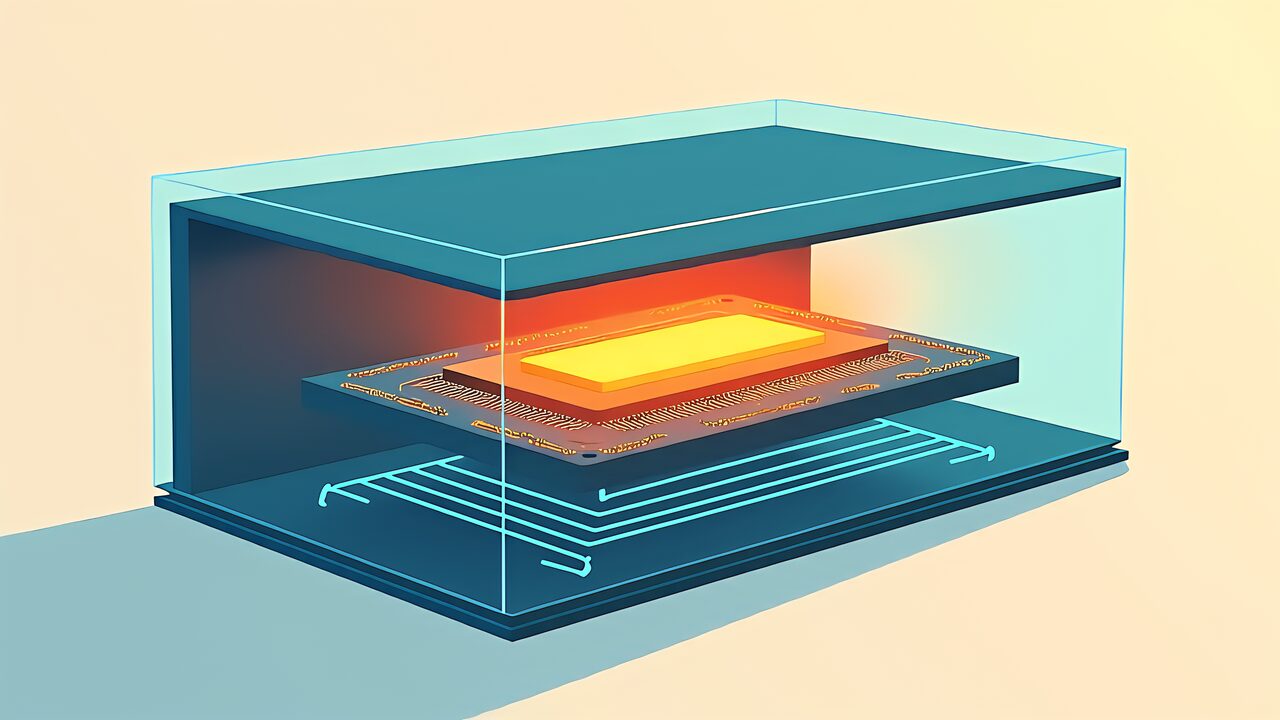
The board went into a sealed printed case and, with no fan and no warning, quietly started throttling itself. Heat problems in 3D printed enclosures are invisible at assembly time — everything works on the open bench, then degrades inside the box. This article covers the numbers that matter: what temperature your filament actually tolerates, how the electronics respond to heat, how to vent a printed case, and where the hard safety lines are.
Polymaker’s data sheet for PolyLite PLA lists a melting point of 150°C — and that number is nearly irrelevant. The same sheet lists a glass transition temperature of 61°C (DSC, 10°C/min), a Vicat softening temperature of 63°C (ISO 306), and heat deflection temperatures of 60°C at 0.45 MPa and 58°C at 1.8 MPa load. The practical takeaway is the 60°C region: that is where PLA softens and, under load, deforms. Note the load dependence — “PLA is fine to 60°C” is imprecise; the accurate statement is “60°C under 0.45 MPa.” A boss preloaded by a tightened screw can creep below the headline number, which is how a box that never saw 60°C still warps.
| Material | Glass transition | Vicat softening | HDT 0.45 MPa | HDT 1.8 MPa |
|---|---|---|---|---|
| PolyLite PLA | 61°C | 63°C | 60°C | 58°C |
| PolyLite PETG | 81°C | 84°C | 78°C | 75°C |
| Polymaker ASA | 98°C | 105°C | 103°C | 100°C |
| PolyLite PC | 113°C | 120°C | 111°C | 107°C |
Moving from PLA to PETG buys nearly 20°C of deflection temperature — the difference between a box that survives a summer car interior and one that does not. ASA adds another 25°C plus weather resistance, and its notched Charpy impact strength of 10.3 ± 0.4 kJ/m² (X-Y) far exceeds PLA’s 3.3 ± 0.2 or PETG’s 2.6 ± 0.2. PC reaches past 100°C but is markedly harder to print. Choose with three questions: indoors or outdoors? direct sun? internal heat source?
A Raspberry Pi begins stepping its clock down from 80°C and hard-limits at 85°C; the Arduino UNO R4 WiFi’s specified operating ceiling is likewise 85°C. A sealed box in a warm room can push an idle SBC into that range with no fan. The symptom is silent: no crash, just a system that got slower after you finished building it.
Passive venting works on one principle: warm air leaves at the top, so let cool air enter at the bottom. Intake low, exhaust high, with the heat source in between. Vents and dust protection pull in opposite directions, so decide which matters more for the installation. If passive is not enough, fans come in standard sizes — 25 / 30 / 40 / 60 / 80 mm — with standardized mounting-hole pitches, and a 40 mm fan is plenty for most hobby boxes. Being able to print TPU anti-vibration grommets for the fan is one of those quiet advantages of owning the printer. What a printed case cannot do well is conduct heat: embedding a metal path is possible but at that point the design is no longer a plain 3D print.
UL 94 classifies polymer flammability. As Protolabs explains it, HB (horizontal burn) is the lowest class; the vertical-burn classes run V-2, V-1, V-0, then 5VB and 5VA. V-0 means a vertically held specimen stops burning within 10 seconds with no flaming drips; V-1 allows 30 seconds; V-2 allows 30 seconds with flaming drips permitted. Critically, the rating is tied to specimen thickness: a resin that passes at 1.5 mm can fail at 0.74 mm, and the material’s UL Yellow Card defines which formulations and thicknesses are covered. A filament sold as “UL94 V-0” earned that rating at a specific test thickness — it does not certify your 1.2 mm printed wall. Do not label your own prints “flame retardant” or “V-0 equivalent.”
Putting AC mains wiring inside a homemade printed enclosure is not recommended, for three reasons: consumer filaments are not certified insulation systems, a fault that chars an uncertified box is a fire path, and certified power supplies already exist to do that job. Draw the line cleanly: let a certified adapter handle AC, bring only low-voltage DC into your printed case, and use the 3D printer for what it is uniquely good at — the carrier, the vents, the grommets, the box itself.
PolyLite PLA deflects at 60°C (0.45 MPa) and 58°C (1.8 MPa); PETG at 78°C and 75°C; ASA at 103°C and 100°C; PC at 111°C and 107°C. A Raspberry Pi throttles from 80°C with a hard limit at 85°C. Choose the material with the three environment questions, vent bottom-to-top, treat UL 94 ratings as thickness-specific test results rather than product properties, and keep AC out of the box entirely. Heat belongs at the start of the design, not the end.