
3D Printer Getting Started Guide: How AI Transformed the Gateway to Making
swiftwand swiftwand.ai
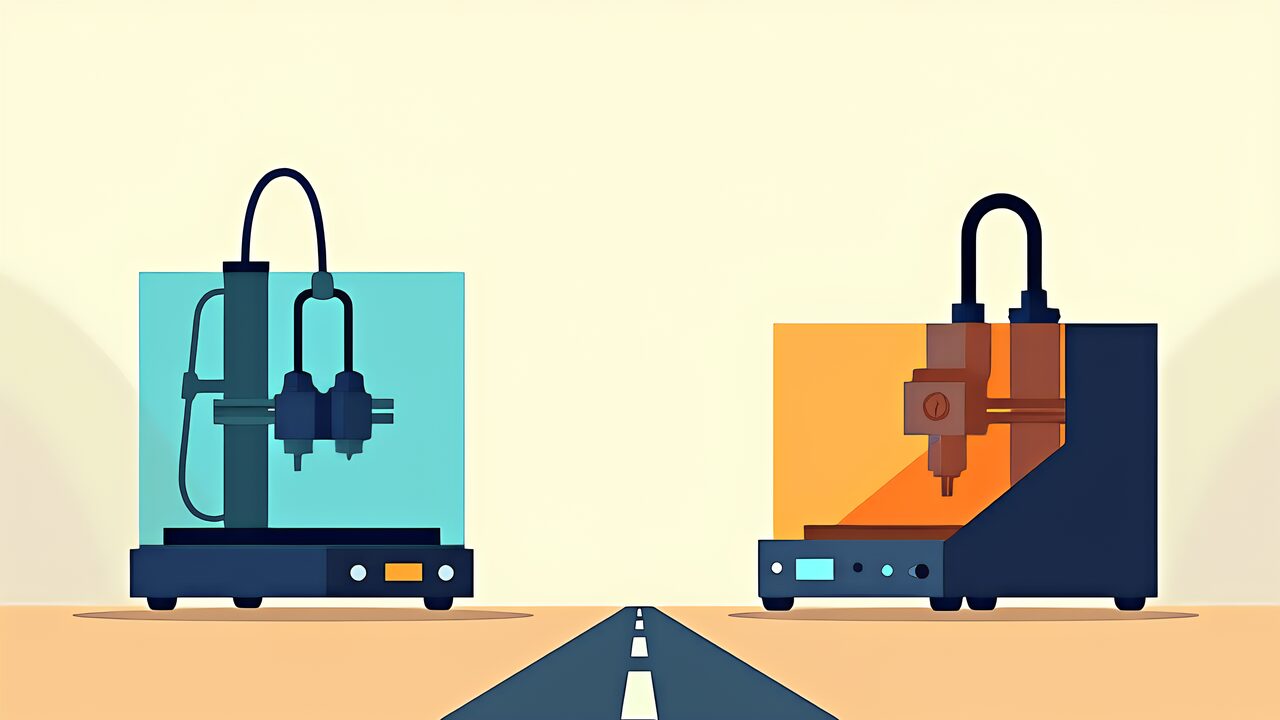
Bambu Lab now sells two machines that both carry a second nozzle, yet they were designed to solve opposite problems. The H2C, which began selling in Japan in January 2026, is a roughly 400,000-yen flagship; the X2D, announced in April, is an affordable dual-nozzle machine starting around 126,000 yen on its own. Reading their spec sheets side by side is not enough to tell them apart, because the meaningful difference lies in design philosophy, not in headline numbers. Dollar figures here are converted at about 161.6 yen to the dollar.
This article contains affiliate links. As an Amazon Associate, we earn from qualifying purchases.
The phrase “dual nozzle” hides two very different goals. On the X2D, the two nozzles exist for division of labor — a main nozzle plus an auxiliary, typically used for “model plus support” or “model plus one more color.” It is the compact, affordable successor to the X1 Carbon, packing a 256 x 256 x 260 mm build volume, speeds up to 1,000 mm/s, and 31 sensors that watch the feed path, temperature environment, and safety into a small enclosed body. Because it does not run two nozzles fully in parallel the way an independent-carriage IDEX machine does, its strength is role separation rather than simultaneous dual printing.
The X2D combines one direct-drive extruder and one Bowden-fed extruder in a single compact enclosed body, switching between them with a nozzle-lifting mechanism. The switch is driven by a gear-and-trigger arrangement that needs no extra motor on the toolhead, which reduces moving mass and vibration and improves motion stability; Bambu states the mechanism has passed life-cycle testing beyond one million switching operations. In single-nozzle mode you get the full 256 x 256 x 260 mm area, while dual-nozzle mode narrows it slightly to about 235.5 x 256 x 256 mm to make room for nozzle parking. The X2D also adds a 65 degree C active heated chamber — the X1C only had passive warming — plus three-stage HEPA filtration. With a 300 degree C nozzle it handles most common engineering needs, especially easy support removal.
The star of the Bambu Lab H2C is the Vortek hotend-change system. Up to six interchangeable hotends sit in a rack beside the printhead, and when the printer needs a different material it picks up the corresponding hotend and brings it to temperature in around eight seconds using inductive heating, enabling up to seven colors or materials in a single build. Because each material keeps its own dedicated hotend, there is no need to purge one color through another. Bambu states this achieves roughly 58% less purge waste than an equivalent single-nozzle approach.
The H2C pairs that system with serious thermal capability. A heated chamber reaching up to 65 degrees C and nozzles up to 350 degrees C let it combine not just PLA and PETG but TPU and high-temperature composites in one print. A PMSM servo extruder delivers about 10 kg of push force, and in multi-nozzle mode the build area is roughly 300 x 320 x 325 mm. Available nozzle diameters include 0.2, 0.4, 0.6 and 0.8 mm. The trade-off is cost and complexity: at around 400,000 yen, with more mechanism to clean and maintain, it asks more of its owner than the X2D does.
| Item | Bambu Lab X2D | Bambu Lab H2C |
|---|---|---|
| Nozzle concept | Lift-type, 1 direct-drive + 1 Bowden | Vortek hotend swap, up to 7 materials |
| Max nozzle temp | 300 degrees C | 350 degrees C |
| Heated chamber | Up to 65 degrees C (active) | Up to 65 degrees C |
| Build volume | 256 x 256 x 260 mm (single) | About 300 x 320 x 325 mm (multi) |
| Max speed | 1,000 mm/s | High-speed CoreXY class |
| Purge handling | Role division, fewer changes | About 58% less purge waste |
| Price (Japan, late June 2026) | About 126,000 yen / 165,000 Combo | About 400,000 yen Combo |
The price gap is the clearest fork in the road. The X2D starts around 126,000 yen on its own and about 165,000 yen as a Combo, putting dual-nozzle printing within reach of a much wider audience. The H2C, at roughly 400,000 yen as a Combo, is a flagship purchase. Sitting between them in Bambu’s lineup is the H2D, which carries two fully independent nozzles and is strong at combining engineering materials with water-soluble supports; it runs roughly 1,899 dollars (about 300,000 yen, and 345,800 yen for the single unit in Japan). Import duties and Japan-specific pricing mean yen figures do not track a simple dollar conversion, so always check the regional store price before buying.
A sealed CoreXY with a material system is the closest thing to a set-and-forget printer.
Start from what you make. If your main goal is clean support removal and the occasional second color, the X2D’s lift-type dual nozzle and 300 degree C hotend cover most materials at a fraction of the cost. If you regularly print three, four or more colors in one model, or combine demanding engineering materials with high-temperature composites, the H2C’s Vortek system and 350 degree C nozzles justify their price by removing the purge-waste mountain and widening the material range. A hobbyist printing mostly single-color or two-tone work rarely needs the flagship; a maker doing rich multicolor or multi-material production will feel the X2D’s limits quickly.
The H2C and X2D share a label but not a purpose. The X2D democratizes dual-nozzle printing for support removal and light multicolor at an affordable price, while the H2C pushes purge-free multi-material to a flagship level with the Vortek system and a hot chamber. Decide which describes your work, and the choice between 126,000 yen and 400,000 yen stops being about specs and becomes about fit.
Bambu Lab H2C official product page and specifications; Bambu Lab X2D technical specifications (Bambu Lab US); 3D Printing Industry: Bambu Lab launches X2D dual-nozzle 3D printer.