3D Printer Print Failure Causes and Solutions: 13 Practical Tips for Beginners
swiftwand swiftwand.ai

This article is a comprehensive summary of the entire 6-article resin 3D printing series. We integrate the knowledge gained throughout the series and propose a “dual wielding” strategy for using FDM and resin appropriately based on application. This guide covers cost estimates from initial investment to running costs, application-specific mapping, and resin technology outlook for the second half of 2026.
Beginning with “Resin 3D Printing Beginner’s Guide 2026,” this series has systematically covered resin fundamentals, material selection, slicer configuration, post-processing, and quality control. Readers who learned about the 7 common failure patterns and AI detection methods in the previous article “AI × Resin 3D Printing Quality Control 2026” have already built the foundational knowledge necessary for successful resin printing. This article integrates that knowledge and provides practical decision-making frameworks.

Before considering FDM vs. resin strategy, let’s review the learning outcomes across the entire series. We organize the role each article played and the insights gained.
Day 1: Resin 3D Printing Fundamentals — We understood the operating principles of resin printers (MSLA method), fundamental differences from FDM, and the photopolymerization mechanism of resin. We confirmed that LCD/MSLA technology brought a price revolution, making consumer resin printers available from approximately ¥20,000.
Day 2: Resin Materials Guide — We learned selection criteria for different resin types: standard resin, tough resin, flexible resin, water-washable resin, and castable resin. We understood that material properties directly influence final print quality.
Day 3: Slicers and AI Integration — We learned about optimizing ChiTuBox and Lychee Slicer settings and utilizing AI support generation features. We confirmed that slicer configuration directly impacts print success rate.
Day 4: Post-Processing Master Guide — We mastered all post-processing steps: cleaning (IPA/water washing), UV curing, support removal, surface finishing, and safety management. We understood that post-processing quality determines the final quality of printed objects.
Day 5: Quality Control and AI Detection — We analyzed 7 common failure patterns (FEP sticking, insufficient supports, warping, delamination, resin degradation, exposure time issues, and build platform contamination) and learned AI-based detection methods.
Day 6: This Article — We synthesize all previous knowledge and provide strategic frameworks for choosing between FDM and resin based on your making goals.
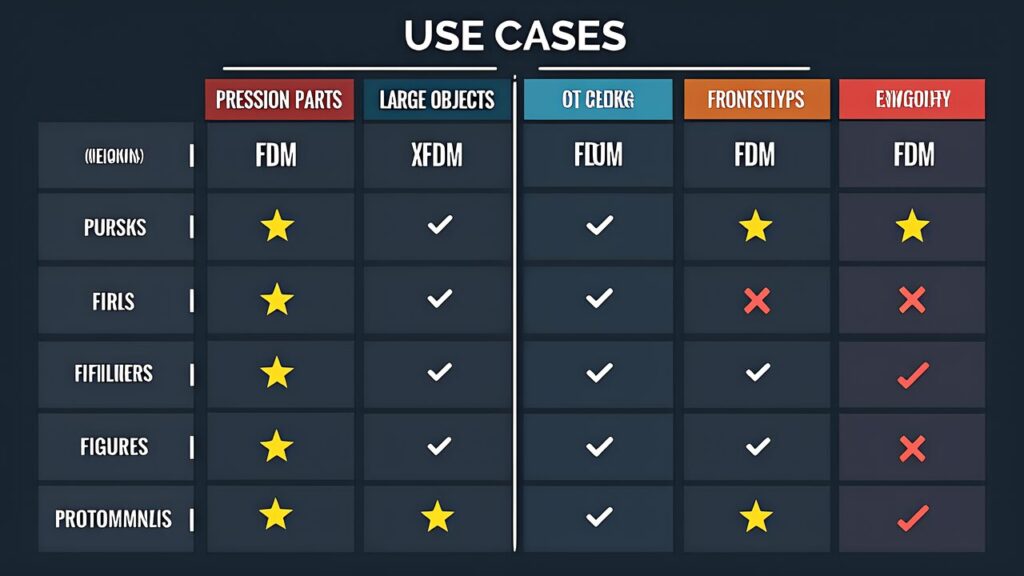
Now that we’ve covered the technical foundations, let’s establish a clear decision framework. FDM and resin printing are not competitors but complementary technologies, each excelling in different scenarios.
Resin overwhelmingly dominates here. MSLA method’s XY pixel pitch of 18μm vs. FDM’s standard 0.4mm (400μm) nozzle—that’s approximately 22 times finer resolution. For applications requiring intricate details—TRPG miniatures, jewelry wax models, dental models—resin is the only choice.
The comparison depends on part size and intended use. MSLA exposure time per layer is typically 1.5–3 seconds, with Z-axis print speed of approximately 20–50 mm/h. FDM machines can move horizontally at 300–500 mm/s, giving faster printing for large parts. For medium-sized parts, FDM often wins on speed.
FDM wins decisively here. PLA, PETG, ABS, TPU, PA (Nylon), PC (Polycarbonate)—the range is vast. Resin materials have expanded with water-washable, ABS-Like, tough, flexible, and high-temperature options, but FDM still offers superior mechanical property range.
Resin printing demands more. After printing, parts require alcohol or water washing, UV curing, and support removal processing. FDM only needs peeling from the bed. Resin handling also requires gloves, goggles, and proper ventilation—safety management overhead that FDM doesn’t need.
Resin costs approximately ¥3,000–8,000 per kilogram. FDM PLA filament ranges from ¥2,000–3,000 per kilogram—resin is more expensive per unit volume. Additionally, LCD panels require replacement every 1,000–2,000 hours—a cost factor absent in FDM.
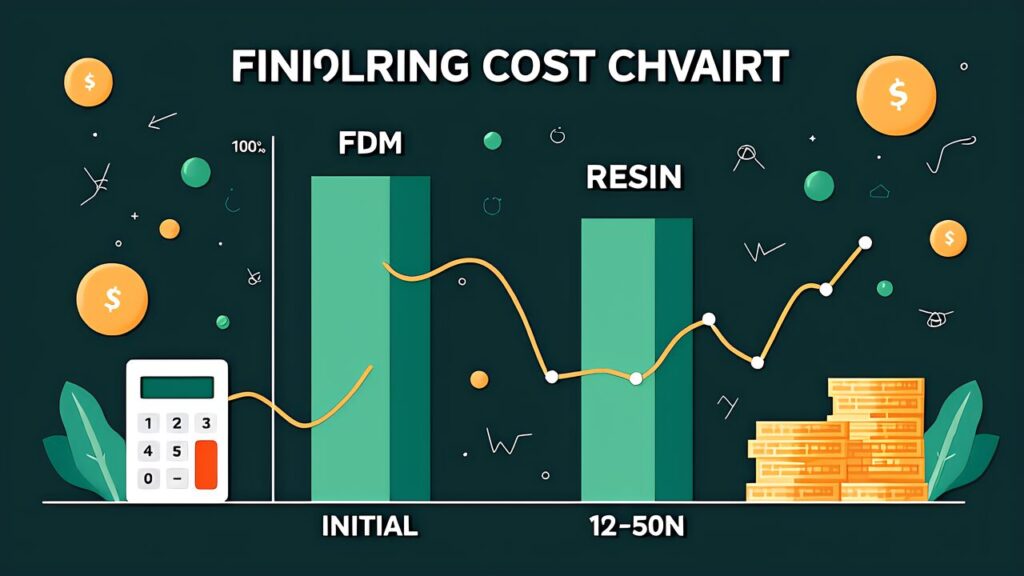
Beyond material costs, let’s analyze complete production economics. The break-even point between FDM and resin depends heavily on part size and batch volume.
For miniatures consuming 3–5 ml of resin (approximately ¥10–15 material cost) at 1.1 g/ml density with ¥3,000/kg resin pricing, resin becomes cost-competitive. Add electricity (approximately ¥3), FEP film amortization (approximately ¥5), LCD depreciation (approximately ¥5), and IPA costs (approximately ¥5)—total production cost approximately ¥35 per unit. For mass-produced miniatures, injection molding requires expensive tooling. Resin 3D printing wins for low-volume, high-detail production.
For medium-sized parts, FDM and resin costs converge. FDM’s advantage is material cost and speed; resin’s advantage is surface quality requiring less post-processing. The decision depends on final product requirements: if tolerances matter more than finish, choose FDM; if surface quality is critical, choose resin.
For large parts, FDM wins decisively. Resin consumption scales cubically with size, making large resin prints economically prohibitive. An 200×200×200mm cube would consume 8 liters of resin—approximately ¥24,000 in material alone. FDM can print the same volume for ¥200–300 in filament.
Rather than choosing one technology exclusively, successful makers adopt a “dual wielding” approach, selecting the right tool for each project:
Scale is large: Enclosures, structural parts, large functional prototypes. Volume ≥ 100cm³ often favors FDM economics.
Material properties matter: Flexibility, high temperature resistance, specific mechanical properties. FDM’s material library is superior.
Turnaround speed is critical: FDM’s faster print and immediate post-processing (no curing, no washing) saves time.
Budget is constrained: FDM machines cost ¥30,000–80,000; resin machines cost similar prices, but resin material costs are 2–3 times higher per volume.
Detail matters above all: Miniatures, jewelry, fine arts, jewelry models. Resin’s 18μm pixel pitch enables detail that FDM cannot achieve.
Surface finish quality is required: Resin parts need less post-processing sanding and finish beautifully straight from the printer (after washing and curing).
Small to medium batch production: 50–500 unit batches. Resin’s per-unit cost remains economical for low-volume production where injection molding tooling is prohibitive.
Precision tolerances are critical: Dental models, jewelry stones, mechanical assemblies. Resin’s superior accuracy enables tighter tolerances.

If you’re investing in resin technology in 2026, consider these emerging trends that will shape the market through year-end.
Elegoo Saturn 4 Ultra 16K’s 15360×8520 pixel resolution (18μm pitch) is approaching physical limits of visible layer lines. Eye-level inspection reveals minimal layer stepping—nearly injection-molded surface quality. This represents the maturation of resin technology’s resolution advantages.
Cold resin dramatically reduces print success rates. Heated vats maintaining resin at 25–35°C eliminate winter-season failures. Anycubic’s latest models ship with integrated heaters. If buying resin equipment in 2026, prioritize heated vat capability as a must-have feature.
Traditional straight-pull release methods created suction forces that damaged delicate parts. Tilt-release mechanisms reduce peel force while accelerating print cycles. This innovation directly increases success rates and print speed—a genuine reliability improvement.

For makers considering both technologies, here’s a practical investment sequence:
Start with FDM if you’re new to 3D printing. Machines like Bambu Lab A1 mini (¥29,999) or Creality K4 Plus (¥38,000) teach fundamental slicing, support design, and part orientation. These months build intuition about layer stacking and structural thinking.
After 3 months of FDM experience, add resin for detail-critical projects. Start with Elegoo Saturn 4 Ultra 16K (¥91,000) or Anycubic Photon Mono M7 Pro. Your FDM intuition transfers directly—support logic, orientation thinking, and batch production mindset all apply.
With both technologies operational, optimize project routing. Large functional prototypes → FDM. Fine details requiring finishing → Resin. Your workshop becomes genuinely versatile, capable of handling any making challenge.
The future of making isn’t “FDM or Resin”—it’s “FDM and Resin.” By 2026, hobby and professional maker spaces increasingly deploy both technologies, treating them as complementary rather than competing.
Choose FDM if: You prioritize material range, large parts, and cost efficiency. Start here if new to 3D printing.
Choose Resin if: Detail quality, surface finish, and small-to-medium batch production drive your projects.
Master both if: You want comprehensive making capability and plan to serve diverse project types professionally.
The technologies have matured sufficiently that choosing between them is no longer about feasibility—it’s about economics, speed, and quality requirements. The dual-wielding maker who understands both technologies’ strengths gains competitive advantage in the modern making landscape.
Armed with this series’ comprehensive knowledge—from resin fundamentals through AI quality control—you’re equipped to make strategic technology decisions. Whether you invest in FDM, resin, or both, your 2026 making projects will benefit from clear strategic thinking about which tool solves each challenge best.