Home Appliance Electricity Costs and Breakdowns with AI — Measure, Repair and Make Before Winter, and What the EU Right to Repair Changed
As winter approaches and the heaters come out of storage, the electricity bill starts to matter. Around the same time, an appliance you have used for years may stop working, and you have to decide whether to repair it or replace it. Electricity costs and breakdowns look like separate worries, but neither can be judged without knowing which appliance uses how much electricity and what exactly broke. This article lays the groundwork for handling both with AI and open data.
This article contains affiliate links. As an Amazon Associate, we earn from qualifying purchases.
Between summer and autumn 2026, several official moves touched this topic at once. In the UK, the energy regulator Ofgem revised its cap on electricity and gas prices on 1 October, and the next cap will be announced by 25 November. The US Energy Information Administration (EIA) published its winter fuels outlook on 6 October. And in the EU, the right to repair directive (Directive 2024/1799) has applied since 31 July 2026, with domestic local space heaters added to the product groups covered by the repair obligation.
This article covers four things:
- What the official winter electricity figures in the UK, the US and Japan actually represent
- How to read an appliance’s electricity cost with the formula “energy × unit price”
- How much of a whole home’s electricity the per-appliance meters captured in one house of REFIT, a UK open dataset
- What the EU right to repair changed and what it did not, and what the legal text says about 3D-printed parts
Note that we did not meter any appliances ourselves. Every figure comes from open data or official documents, and the REFIT aggregation is a single calculation we ran with a Python script. The legal descriptions summarize our reading of the legal texts and the European Commission’s announcements and explanatory material; they are not legal advice.
- Where winter electricity prices stand now — official figures from the UK, the US and Japan
- Read appliance electricity cost as “energy × unit price”
- Reading one home’s winter in open data — REFIT House 1
- What the EU right to repair directive changed
- Domestic local space heaters added — Delegated Directive 2026/74 and ten years of parts
- What the directive says about 3D-printed parts
- Measure, repair, make — splitting winter appliance costs and breakdowns into three
- Lines readers in Japan should know first
- Summary — check your unit price, then decide what to measure
- Sources
Where winter electricity prices stand now — official figures from the UK, the US and Japan
We start with one value from each of the three countries. The three are defined differently, though: the UK figure is a cap, the US figure is a projection, and the Japanese figure is a reference rate. We also did not take an exchange rate, so rather than converting the three into yen and lining them up, we read each one within its own country.
UK: Ofgem’s cap applies to unit rates and standing charges
Ofgem caps the unit rate and the standing charge that suppliers can charge on standard (standard variable) tariffs. According to its announcement of 26 August 2026, the electricity cap for 1 October to 31 December is an average of 26.32 pence per kWh for direct debit customers, with a standing charge of 54.83 pence per day. These are averages for England, Scotland and Wales and do not include Northern Ireland.
The key point is that the cap applies to the unit rate and the standing charge, not to the bill. Ofgem says the annual figure for a typical household using both electricity and gas rises by £60, from £1,663 to £1,723. But that is a guide to what a year at this level would cost, not a cap on the bill. If a household uses more energy, the bill rises accordingly. Households on fixed-price deals are not affected by the change in the cap, and households that do not use gas see an increase of less than 1%.
The other point is tax. The UK government has removed VAT on electricity from 1 October 2026 to 31 March 2027. The 26.32 pence therefore excludes VAT, while gas still carries 5% VAT. Ofgem itself notes that, because of this change, the figures cannot be compared directly with previous periods. The typical annual figure is also calculated with typical consumption values revised in July 2026.
The next cap (for 1 January to 31 March 2027) will be announced by 25 November. Ofgem says it may publish earlier if external circumstances require it. On this article’s publication date (2 November), the October to December values are in force; values from January must be checked in Ofgem’s announcement once published.
US: the EIA projects winter bills for homes that heat with electricity
The EIA’s Winter Fuels Outlook 2026-27 (published 6 October 2026) projects what households will pay for fuel over the winter (November to March), by main heating fuel. For homes that heat primarily with electricity, it expects residential electricity prices to rise 3% and consumption to rise slightly, so bills go up 4%.
A table on the same page gives the national average for homes heating primarily with electricity: $1,196 in expenditure, 6,562 kWh of consumption and 18.23 cents per kWh for November to March combined. Monthly expenditure is $213 in November, $253 in December, $270 in January and $230 each in February and March.
There are three things to keep in mind. First, this is a base-case projection, not an actual figure. Second, the expenditure and consumption are for electricity used as the main heating fuel, not the cost of heating alone; it is more accurate to read them as the projected winter electricity bill of a home that heats with electricity. Third, the EIA itself warns readers not to assume that switching to a fuel with lower expenditures would lower their own costs.
Japan: the 31 yen/kWh reference rate and the state of winter support
Electricity costs printed in Japanese appliance catalogs are calculated with a reference unit price set by the National Fair Trade Council of Home Electric Appliances (Kaden Kotorikyo). The current reference rate is 31 yen per kWh including tax, revised on 22 July 2022. When we checked on 26 October 2026, it had not changed. We used the same reference rate for 3D printer electricity in Recalculating 3D Printing Costs at Japanese Electricity Rates (published 19 August 2026).
The council itself notes that electricity prices differ depending on the retail electricity supplier you contract with. The reference rate is a common yardstick for aligning catalog values, not your household’s unit price. When calculating your own electricity cost, the unit price on your supplier’s statement is closer to reality.
Winter support has not been decided yet. The special site for electricity and gas price support run by the Agency for Natural Resources and Energy (METI) covers usage only up to July to September 2026, and as of 26 October 2026 we could find no formal government announcement of support for winter usage. Kyodo News (21 October 2026) reported that the government had begun considering subsidies for winter electricity and gas prices. This article does not assume whether a winter subsidy will exist or how large it will be; please check the special site for anything decided after publication.
Read appliance electricity cost as “energy × unit price”
Having seen how the national figures differ, we can align the shape of the calculation. An appliance’s electricity cost can be read with this formula:
Electricity cost = energy (kWh) × unit price (yen/kWh, pence/kWh or cents/kWh)
Energy (kWh) = power draw (W) × hours used (h) ÷ 1000
The unit price is the part you fill in with your own contract’s value. The three values above can serve as examples: in Japan, the council’s reference rate of 31 yen/kWh; in the UK, Ofgem’s October to December cap of 26.32 pence/kWh; in the US, the EIA’s projected November to March average of 18.23 cents/kWh for homes heating with electricity. Each value only means something within the conditions of its source and date.
You can confirm with the EIA table that the formula works on real numbers. Multiply the 6,562 kWh consumed by electrically heated homes from November to March by 18.23 cents/kWh: 6,562 × 18.23 = about 119,625 cents, or about $1,196. That matches the $1,196 expenditure in the table. The three values in the table are linked by this formula.
Some charges do not fit into the formula, though. The UK cap includes a standing charge of 54.83 pence per day, which accrues by the day regardless of energy used. Writing a UK household’s electricity cost with the cap’s unit rate and standing charge gives “energy × 26.32 + days × 54.83” (in pence). But the standing charge applies to the whole home, so when thinking about the cost of a single appliance you only need the energy part. For the breakdown of Japanese tariffs, check your supplier’s terms or statement.
The calculation so far is simple. The hard part is knowing the per-appliance energy that goes into the formula. Your supplier’s statement shows the energy for the whole home, not how many kWh each appliance used. To think about appliance costs one by one, you have to measure each appliance. So what becomes visible when you meter appliances individually, and what does not? The next section reads one home in open data.
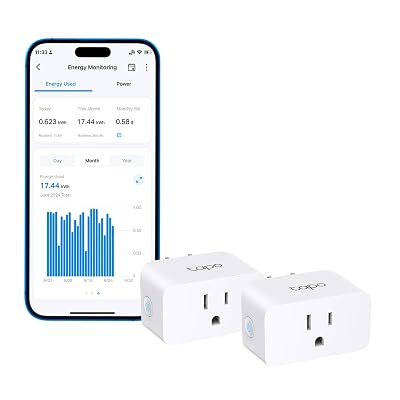
Per-appliance energy can be recorded with a smart plug placed between the outlet and the appliance. The Tapo P115 sold in the US shows power and energy use in its app and is rated for 15 A.
 ポチップ
Reading one home’s winter in open data — REFIT House 1
Data and method
REFIT is a dataset of whole-home and per-appliance electricity measured in 20 homes in Loughborough, UK. It is published by a research team including the University of Strathclyde. The period is 2013 to 2015 (October 2013 to June 2015 on the distribution page), and values are active power in watts at a nominal 8-second interval; the actual spacing between rows is uneven. In each home, nine appliances were measured with plug-in meters (IAMs), and the whole home was measured separately. The license is CC BY 4.0.
Before choosing a home, we checked the nature of the data. According to the paper, every REFIT home is heated mainly by gas central heating, with no other air-conditioning system. With that in mind, we calculated the three homes that metered an electric heater (Houses 1, 9 and 16) and read House 1 in detail. House 1 is a two-person, four-bedroom detached house built in 1975 to 1980, with 35 appliances. Solar generation was removed by wiring, so it does not leak into the whole-home value (Houses 3, 11 and 21 do include it and cannot be used to calculate shares of the whole).
We calculated with the following rules:
- Energy is the sum of each row’s watts × seconds until the next row. Intervals with more than 120 seconds to the next row, and rows where the metered appliances added up to more than the whole home (rows with Issues = 1), are not counted
- Days with fewer than 23 hours of data are excluded. Days are split by UK local time
- “Winter” is 1 December 2014 to 28 February 2015; House 1 had 87 days meeting the conditions (480 days over the whole period)
- Appliance names follow the appliance list in the README from the distributor (University of Strathclyde). The data was taken from the distributor, and we confirmed the House 1 file is identical to the Zenodo copy (DOI 10.5281/zenodo.5063428)
- The “unmetered” share is whole-home energy minus the sum of the nine appliances
Result: nine meters saw only 26.2% of the home’s winter electricity
The table shows House 1. Values are energy per day (kWh/day) and the share of the whole home.
| Appliance (README name) | Winter kWh/day | Winter share of whole home | Whole period kWh/day | Whole-period share |
|---|---|---|---|---|
| Whole home (Aggregate) | 14.125 | 100.0% | 10.694 | 100.0% |
| Fridge | 0.38 | 2.7% | 0.408 | 3.8% |
| Freezer (1) | 0.31 | 2.2% | 0.395 | 3.7% |
| Freezer (2) | 0.683 | 4.8% | 0.691 | 6.5% |
| Washer Dryer | 0.025 | 0.2% | 0.027 | 0.3% |
| Washing Machine | 0.361 | 2.6% | 0.202 | 1.9% |
| Dishwasher | 0.364 | 2.6% | 0.256 | 2.4% |
| Computer | 0.095 | 0.7% | 0.059 | 0.6% |
| Television Site | 0.131 | 0.9% | 0.137 | 1.3% |
| Electric Heater | 1.345 | 9.5% | 1.195 | 11.2% |
| Unmetered | 10.43 | 73.8% | 7.323 | 68.5% |
In winter the whole home used 14.125 kWh per day. The nine meters captured 26.2% of that (100 − 73.8), and the remaining 73.8% belongs to appliances that were not metered. In other words, even with nine per-appliance meters, about three quarters of the home’s winter electricity was invisible. The unmetered share includes lighting, cooking appliances and anything plugged into an outlet without a meter.
The pattern was not unique to House 1. With the same calculation, the unmetered share in winter was 66 to 68% of the whole home in House 9 and House 16 as well.
How to read it
We read the numbers from four angles.
First, among the nine metered appliances, the electric heater was the largest in winter at 1.345 kWh per day, or 9.5% of the whole home. However, the fridge and the two freezers together come to 0.38 + 0.31 + 0.683 = about 1.37 kWh per day, roughly the same as the heater. Cooling appliances are small one by one, but they add up as the count grows.
Second, the heater’s whole-period average of 1.195 kWh per day is not very different from its winter value of 1.345 kWh. That does not mean seasonal differences are small. Looking at the same data month by month, this heater was barely used from May to October and was used from November to April. On the other hand, January 2015, which falls inside our winter window, saw almost no use. The whole-period average includes the 2013-14 winter and March 2015, when the heater was used more. A per-day average changes a lot depending on which months it includes. The main heating in REFIT homes is gas, and this heater is supplementary.
Third, the whole home uses more in winter (14.125 kWh per day in winter versus 10.694 kWh over the whole period). But most of the increase is an increase in the unmetered share (10.43 kWh per day in winter versus 7.323 kWh over the whole period). This data cannot tell what used more electricity in winter, because the contents of the unmetered share are invisible.
Fourth, we compared with the paper’s figures. The paper’s table gives the share of energy captured by the plug meters in House 1 as 35% (over the whole monitoring period). Our whole-period value is 100 − 68.5 = 31.5%, which is in the same range. Because we used the cleaned data and excluded days and intervals by the rules above, it does not match the paper exactly.
Putting it into the formula
Here is how to put this home’s values into the formula from the previous section. House 1’s heater used 1.345 kWh per day in winter. Over 30 days:
Energy = 1.345 kWh/day × 30 days = 40.35 kWh
Cost = 40.35 kWh × your contract unit price
(Example) With the Japanese reference rate of 31 yen/kWh: 40.35 × 31 = about 1,251 yen
This example only shows how to use the formula. It applies a Japanese reference rate to one UK home’s usage in the 2014-15 winter. It does not represent heating costs in Japanese homes, nor the bill of a home heated by electricity.
What this calculation cannot tell you
No general conclusions can be drawn from this result. To be clear about what cannot be said:
- These are winter 2014-15 values from one UK home (three if you count the homes we compared), calculated once. They cannot be applied to other homes or to homes in Japan
- REFIT homes are mainly heated by gas, so this does not represent the breakdown of an electrically heated home
- The share of the nine metered appliances is not “the home’s electricity breakdown”. The unmetered share exceeds 70%
- Voltage was not measured and is assumed to be 240 V. Energy is each reading multiplied by the time to the next reading, and the paper acknowledges this can come out high or low. In homes without solar, the difference from the utility meter reading was generally under 12%, it says
- In the cleaned data, meter values above 4000 W were replaced with 0
- We did not check the type and rating of the heater, or whether the metered appliances were swapped during the period
Attribution: the values in this section are our aggregation of the dataset “REFIT: Electrical Load Measurements (Cleaned)” (David Murray et al., University of Strathclyde, DOI 10.15129/9ab14b0e-19ac-4279-938f-27f643078cec, licensed CC BY 4.0). The data are described in Murray, Stankovic and Stankovic, “An electrical load measurements dataset of United Kingdom households from a two-year longitudinal study” (Scientific Data 4, 160122, 2017).
The REFIT aggregation above was a short Python script. If you want to read files like this yourself, a book that teaches practical Python from file handling upward is a good place to start.
 ポチップ
What the EU right to repair directive changed
From here we move to the breakdown side. The EU right to repair directive (Directive 2024/1799) was adopted on 13 June 2024 and published in the Official Journal on 10 July 2024. “Right to repair” is the common name; the official English title is “on common rules promoting the repair of goods”. Member States apply national rules based on the directive from 31 July 2026. We did not check how far each Member State has transposed it.
To be clear from the start, this is a system for EU Member States and does not apply directly to consumers in Japan. For Japanese readers, it is best read as material on how a repair regime can be put together.
It covers faults outside the seller’s legal liability
The directive deals with repairing faults that the seller’s statutory liability, the legal guarantee, does not cover. The legal guarantee is the seller’s liability under the EU sale of goods directive (2019/771): if a lack of conformity that existed at delivery becomes apparent within two years, the seller is liable. Those two years are the EU minimum, and Member States may set longer periods. It is separate from any voluntary warranty offered by the manufacturer.
“Not covered by the legal guarantee” does not only mean after the period has ended. It includes faults after the legal guarantee period and faults during it for which the seller is not liable. The Q&A from the Commission’s services (30 July 2024; it notes that it is not the Commission’s official position) says the manufacturer’s repair obligation starts when the consumer buys the product, and gives faults caused by the consumer as an example of what the free repair under the legal guarantee does not cover. Even then, it says, the consumer can ask the manufacturer for repair if the product is in Annex II and spare-part requirements apply to that product group.
The repair obligation covers only the 11 items in Annex II
The manufacturer’s repair obligation applies only to products listed in Annex II of the directive. For each product group, Annex II lists the EU regulation that sets its reparability requirements (spare parts, disassembly, software updates and so on). Checked against the official text on 26 October 2026, there are 11 entries:
- Household washing machines and household washer-dryers
- Household dishwashers
- Refrigerating appliances
- Electronic displays
- Welding equipment
- Vacuum cleaners
- Servers and data storage products
- Mobile phones, cordless phones and slate tablets
- Household tumble dryers
- Goods incorporating light means of transport batteries
- Domestic local space heaters (added by a 2026 delegated directive; see the next section)
Put the other way, microwaves, electric kettles, toasters and air conditioners are not named among these 11. The directive does not create a manufacturer repair obligation for them.
The obligation works as follows. For Annex II goods, to the extent that the EU regulation for that group sets reparability requirements, the manufacturer must repair at the consumer’s request unless repair is impossible (Article 5(1)). Being named in Annex II does not put every fault of that product under the obligation. The Commission’s Q&A explains that in practice it concerns faults in parts the manufacturer must supply as spare parts under the regulation, and only for the period during which those parts must be supplied. Repair must be free of charge or at a reasonable price, and, in the Commission’s explanation, within a reasonable time. For manufacturers outside the EU, an authorised representative, the importer or others take on the obligation. Consumers can also choose any repairer, not only the manufacturer. In short, this is not a system where “anything gets fixed for free”. It sets out who you can ask and at what price for faults within the scope of the regulation for the repairable product groups.
Extension of the legal guarantee, and its conditions
The directive also amends the sale of goods directive (2019/771). If, during the legal guarantee period, the consumer chooses repair rather than replacement, the seller’s liability period is extended once by 12 months. Member States may go further, so the Commission describes it as “at least 12 months”. The extension does not apply to sales contracts concluded before 31 July 2026. Note that what is extended is the seller’s liability period, not the manufacturer’s warranty.
Spare parts, repair information and a site for finding repairers
On spare parts, the directive addresses price. A manufacturer that supplies spare parts and tools must offer them at a reasonable price that does not deter repair. The directive itself, however, does not say how many years parts must be available. Whether a supply period is set, and how long it is, depends on the EU regulation listed for each product group in Annex II (mostly ecodesign regulations).
On information, manufacturers show indicative prices for typical repairs on a free website. Repairers may give consumers a “European Repair Information Form” summarizing the repair terms (it is optional). A “European online platform for repair” is also to be set up so consumers can find repairers.
For the platform, it helps to separate the legal deadline from the expected start. Under the text, the Commission develops a common interface by 31 July 2027, and Member States use it to set up national sections. A Member State that already has a national repair site covering its whole territory and meeting the requirements (public or private) does not need a national section; the platform links to that site instead, which must be running by 31 July 2027. A Member State that sets conditions for repairers to register in its national section brings that section into operation within six months of receiving the common interface. On timing, the Commission’s announcement of 31 July 2026 said the platform should become operational in 2027, while the Commission’s page on the directive, checked on 26 October 2026, says it is foreseen to become operational in January 2028. At that point the platform was not yet running.
The product groups in Annex II are not fixed; the Commission adds them by delegated acts. The heater in the next section is an example.
Domestic local space heaters added — Delegated Directive 2026/74 and ten years of parts
For winter appliances, Delegated Directive 2026/74 matters. It was adopted on 12 January 2026, published in the Official Journal on 20 April and applied by Member States from 31 July 2026. It adds point 11, “domestic local space heaters”, to Annex II and links their reparability requirements to Regulation 2024/1103.
A local space heater heats the room it is in directly. In the regulation’s definition, it converts electricity, gas or liquid fuel directly into heat to warm the room where it is installed. Among products in Japan, electric stoves and oil-filled radiators are close examples, but gas and liquid-fuel heaters are included as well as electric ones. The regulation also defines a “portable electric local space heater”, one with a cord and plug that can be moved from room to room.
Regulation 2024/1103 has applied since 1 July 2025. On spare parts, it requires the following:
- For electric local space heaters, for models placed on the market from 1 July 2025, manufacturers, importers or authorised representatives make parts such as controls, thermostats, the motor in fan heaters, printed circuit boards, displays and buttons available to professional repairers (the parts list differs by type, such as portable, fixed and storage heaters)
- The supply period is at least ten years after the last unit of the model is placed on the market
- Remote controls, for all local space heaters, not only electric ones (models placed on the market from 1 July 2025), are made available to both professional repairers and users, also for at least ten years after the last unit
- Spare parts are delivered within ten working days of the order
As this shows, it is not the case that “anyone can buy heater parts for ten years”. The specified parts of electric heaters are supplied to professional repairers for ten years. The only part listed as available to users as well is the remote control, which applies regardless of fuel, also for ten years. We did not check the part supply periods for other product groups such as washing machines and fridges, so we do not state them here.
What the directive says about 3D-printed parts
The right to repair directive includes a provision that mentions 3D-printed parts. It is in Article 5(6), which prohibits manufacturers from doing the following:
not impede the use of original or second-hand spare parts,
compatible spare parts and spare parts issued from 3D-printing,
by independent repairers when those spare parts are in conformity
with requirements under Union or national law such as requirements
on product safety or in compliance with intellectual property
In plain terms: a manufacturer must not prevent independent repairers from using original, second-hand or compatible spare parts, or spare parts made by 3D printing, provided those parts comply with requirements under EU or national law, such as product safety requirements or intellectual property requirements. The protection of intellectual property is dealt with separately from this provision.
It is worth reading this provision carefully. The subject is the manufacturer, and what is protected is independent repairers’ use of parts. It also applies only to Annex II products. So it cannot be read in the following ways:
- “The EU approved 3D-printed parts”: the provision only prohibits manufacturers from getting in the way. It does not guarantee that parts are safe, and it presupposes that they comply with legal requirements
- “Consumers gained a right to repair with their own parts”: the provision concerns independent repairers and is not written as a consumer right
- “A repair with a 3D-printed part keeps the manufacturer’s warranty”: the provision says nothing about manufacturer warranties
Note also that the heater parts periods in the previous section come from EU regulations and cannot be applied to the situation for spare parts in Japan. We described the steps and thinking for making your own part, from measuring to redesign, in 3D Printed Repair Parts 2026 — Reviving Discontinued Components with Calipers and AI CAD (published 25 July 2026). The responsibilities that arise when you give or sell a part you made are covered in What Individuals Must Disclose When Selling in Japan: SCTA and the PL Act (published 21 August 2026).
Measure, repair, make — splitting winter appliance costs and breakdowns into three
Here we rearrange everything so far into the order you would act. Reading an appliance’s electricity cost with the formula needs per-appliance energy. Deciding whether to repair or replace a broken appliance requires knowing what gets fixed and what does not. And when a part cannot be obtained, the question becomes whether it can be 3D printed. We split this into “measure”, “repair” and “make”, and publish one article a day from 3 to 8 November.
In the four articles that use AI (3, 5, 6 and 7 November), the role of AI takes the same shape. We let AI read power logs, classify the free-text notes in repair records, or sort candidate parts. Then we prepare the correct answers by another method (a Python script, labels attached to the data, or rules decided in advance) and count how often the AI matched. Every experiment is a single run per condition, and results are written as “this is what happened in this run”.
Measure
- 3 November: let AI read per-appliance power logs and count how its readings of standby power and the most-used appliance compare with answers computed in Python
- 4 November: downsample REFIT’s nominal 8-second data to coarser intervals and count how a smart plug’s export interval changes what you see of energy and of appliances that run only briefly
Just as more than 70% of House 1 in this article was unmetered, what you see depends on how you measure. Deciding what to measure, and at what interval, is the starting point for thinking about appliance electricity costs.
Repair
- 5 November: count in the open records of repair events (Open Repair) what got fixed and what did not, and why. We have AI classify the free-text fault descriptions and compare with the data’s labels
- 6 November: calculate repair versus replace by electricity cost, using measurements of old fridges and the registered values of current models, and check the AI’s calculation against Python’s
Make
- 7 November: decide how far you can 3D print appliance parts you cannot buy with lines for heat, food, electricity, strong force and rotation, and mouth and skin, and have AI sort candidates
- 8 November: a reverse lookup of where to start (measure, repair or make) by symptom, appliance and budget
In every installment, conclusions are written after seeing the experimental results. Here we only lay out the questions and the procedures in advance.
Lines readers in Japan should know first
Finally, here are the lines not to cross when measuring or repairing appliances in Japan.
Do not touch wiring; deal only with the appliance side
This article, and the articles published from 3 to 8 November, deal only with the appliance side beyond the outlet. We do not touch wiring inside walls or the outlets themselves. In Japan, wiring work in homes is governed by licensing rules (the Electrical Work Practitioner Act), and we do not go into the details here.
We treat opening appliances with the same care. Disassembling an appliance can change how the manufacturer’s warranty applies, and touching live parts risks electric shock. Before disassembly, check the conditions in the warranty card and manual, and unplug the appliance first.
Do not read the EU rules as if they were Japan’s
The extension of the EU legal guarantee and the ten years of heater parts are rules for EU Member States. They are separate from Japanese manufacturer warranties, the contract non-conformity liability in the Civil Code, and the periods for which repair parts are kept, and this article did not research the Japanese side. Please do not read the EU rules as applying to appliances bought in Japan. We also do not describe the UK as covered by the EU directive.
Notes on tools for measuring at home
To find per-appliance energy at home in Japan, you can use a meter known as a watt checker (or watt monitor). Products differ in which appliances they can be used with, though, so check the specifications before measuring a heater. The following is from the manufacturers’ official pages; we have not used any of these products.
- Ratoc Systems RS-BTWATTCH2 connects appliances up to 100 V/15 A and 1500 W (as of 26 October 2026 the manufacturer’s product page shows it as “shipping ended”, so buying a new one requires checking distribution stock). The manufacturer states that it can also be used to measure household heating and cooling appliances. Records are kept in the unit and viewed in a smartphone app. The one-hour graph uses one-minute values and keeps about one day. List price is 6,800 yen excluding tax
- Ratoc Systems RS-WFWATTCH2 is a Wi-Fi model rated 15 A, 100 V (up to 1500 W). It is for three-prong outlets only. List price is 7,800 yen excluding tax
- Sanwa Supply TAP-TST8N (official name “Watt Monitor”) is a display-reading meter that measures power up to 1650 W. Its rated capacity is 15 A, 100 V (equivalent to 1500 W at 100 V), so 1650 W is the upper end of the measuring range, not the maximum you may connect. Its cautions also ask you not to use it with equipment that must be connected directly to a wall outlet, such as heating appliances, cooking appliances, air conditioners, refrigerators, washing machines and dryers. List price is 6,820 yen including tax
In other words, you cannot generally say “a watt checker can measure a heater”. All three products are rated 15 A, 100 V, cannot be used with appliances over 1500 W, and cannot be used with 200 V air conditioners. Prices are the manufacturers’ list prices; we did not check actual selling prices.
In North America, the Kill A Watt P4400 is a common plug-in meter for the same purpose. It shows an appliance’s power draw and cumulative kWh on its display. As with the Japanese products above, check the manual for which appliances and loads it supports before plugging in a heater.
 ポチップ
Summary — check your unit price, then decide what to measure
The main points of this article:
- Official winter electricity figures mean different things by country. Ofgem’s 26.32 pence/kWh in the UK is a cap on the unit rate, not on bills, and the next cap will be announced by 25 November. The EIA’s $1,196 in the US is a projection for November to March for homes heating with electricity. Japan’s 31 yen/kWh is a reference rate for catalogs, and winter support was still undecided as of 26 October 2026
- Appliance electricity cost can be read as “energy × unit price”, with your own contract’s unit price. The hard part is the per-appliance energy
- In House 1 of REFIT, a UK open dataset, nine per-appliance meters captured 26.2% of the whole home in the 2014-15 winter, and 73.8% was unmetered. The electric heater used 1.345 kWh per day, or 9.5%, but the home’s main heating is gas
- The EU right to repair directive created a route to ask manufacturers for repair of faults outside the seller’s legal liability, only for the 11 product groups in Annex II and to the extent that the EU regulation for each group sets reparability requirements (unless repair is impossible). Choosing repair during the legal guarantee extends the seller’s liability period, and from 31 July 2026 domestic local space heaters are covered too. Ten years of heater parts means specified parts of electric heaters for professional repairers; the only part users can also buy, regardless of fuel, is the remote control. The provision on 3D-printed parts means manufacturers must not obstruct independent repairers
Two things you can do right away: check your unit price on your supplier’s statement, and decide which appliance’s electricity cost you want to know, then check in the specifications that your meter can be used with it. An appliance’s electricity cost can only be calculated once you have both the unit price and the per-appliance energy.
Sources
- European Commission, “Right to repair: New consumer rights for easy and attractive repairs” (2026-07-31)
- European Commission, “Directive on repair of goods”
- European Commission, “Directive on common rules promoting the repair of goods: Questions and Answers” (2024-07-30, PDF)
- Directive (EU) 2024/1799 Official Journal text (Publications Office of the EU)
- Directive (EU) 2024/1799 (EUR-Lex)
- Commission Delegated Directive (EU) 2026/74 Official Journal text (Publications Office of the EU)
- Commission Delegated Directive (EU) 2026/74 (EUR-Lex)
- Commission Regulation (EU) 2024/1103 Official Journal text (Publications Office of the EU)
- Directive (EU) 2019/771 Official Journal text (Publications Office of the EU)
- Ofgem, “Changes to energy price cap between 1 October and 31 December 2026”
- Ofgem, “Energy price cap will rise by 4% from October 2026”
- U.S. EIA, “Winter Fuels Outlook 2026-27”
- National Fair Trade Council of Home Electric Appliances, FAQ (Japanese)
- Agency for Natural Resources and Energy, electricity and gas price support (Japanese)
- Kyodo News, government considers January to March electricity and gas subsidies (2026-10-21, NEWSjp, Japanese)
- University of Strathclyde, “REFIT: Electrical Load Measurements (Cleaned)”
- Zenodo, “REFIT: Electrical Load Measurements (Cleaned)”
- Murray, Stankovic & Stankovic, “An electrical load measurements dataset of United Kingdom households from a two-year longitudinal study” (Scientific Data, 2017)
- Creative Commons, “Attribution 4.0 International”
- Ratoc Systems, Bluetooth Watt Checker RS-BTWATTCH2 (Japanese)
- Ratoc Systems, Wi-Fi Watt Checker RS-WFWATTCH2 (Japanese)
- Sanwa Supply, TAP-TST8N (Japanese)