Smartphone 3D Scanning 2026 Comparison — Polycam vs KIRI Engine vs Scaniverse vs RealityScan
swiftwand swiftwand.ai

The satisfying click of a snap-fit closure is one of plastic’s great inventions — and one of 3D printing’s great frustrations, because the first printed clip usually snaps off instead of snapping in. Snap-fit design is not guesswork; it is a small triangle of geometry — arm length, thickness, engagement depth — plus a material’s allowable strain and the print’s layer direction. This article walks the cantilever fundamentals, the fillet and taper details that keep stress out of the root, material choices, LLM-assisted sizing, FEA sanity checks in Fusion, and the living hinge as the discipline’s advanced class.
This article contains affiliate links. As an Amazon Associate, we earn from qualifying purchases.
An eyeballed clip fails because intuition optimizes the wrong variable. It feels natural to make a clip stubby and thick — sturdy-looking — yet bending strain in a cantilever concentrates at the root and grows with thickness while shrinking with length squared. The stubby clip is precisely the fragile one. A longer, thinner arm bends farther at lower strain, which is why injection-molded products hide surprisingly slender snaps inside their shells. Understanding that one inversion — long and thin beats short and fat — is half the discipline.
Three families cover practical use. The cantilever snap — a flexing finger with a hook — is the workhorse and the focus here. The annular snap is a full ring that stretches over a lip, as on pen caps and bottle closures; it distributes strain around the circumference and prints well vertically. The torsional snap twists a bar instead of bending a beam and suits latches that must open with a press. Master the cantilever first: its math is simplest and its failure modes teach everything the other two reuse.
Three numbers rule the cantilever. Engagement depth — how far the hook must deflect to pass its catch — is the demand side: start near 1 mm and resist the urge to add security by adding depth. Arm length and thickness are the supply side: root strain scales with deflection times thickness divided by length squared, so doubling length quarters the strain while doubling thickness doubles it. For a small case lid, an arm 10 to 15 mm long, 1.2 to 2 mm thick, with about 1 mm of engagement is a sane opening bid — a starting point for testing on your machine and material, not a universal answer. Add a lead-in angle around 30 degrees for smooth insertion, and a steeper retention face, up to 90 degrees for a permanent snap.
Two refinements separate toy snaps from engineered ones. A fillet at the arm root — radius around half the arm thickness — removes the sharp corner where cracks are born; this single detail often doubles survival. Tapering the arm from a thick root to a thinner tip spreads bending strain evenly along the length instead of piling it at the base; a tip around half the root thickness is the classic proportion from injection-molding handbooks and prints without complaint.
Every material grants a strain allowance, and PLA’s is small. Polymaker’s published measurements for its popular PLA line show elongation at break around 13.8 percent in-plane — but that is the tearing point, not a working number; repeated-use snaps should stay far below it, and PLA additionally embrittles with age and stress cycles. PETG flexes back where PLA cracks, making it the sensible default for snaps you open more than once. ABS and ASA behave similarly with better heat tolerance. For high-cycle latches, nylon is the endurance champion. The same geometry that survives two cycles in PLA can survive hundreds in PETG — material choice is not a detail, it is a design variable of equal rank with geometry.
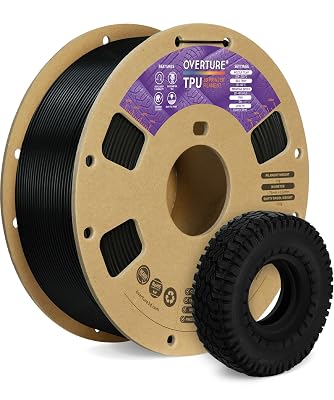
PETG as the default, and TPU for parts that move a lot.
 ポチップ
ポチップThe silent killer of printed snaps is layer direction. If the arm bends in a plane that peels layers apart, the root becomes a perforation line — Polymaker’s data puts interlayer strength at roughly half of in-plane, and cyclic flexing exploits exactly that weakness. Print the clip so bending stress runs along the layers: for most cantilever snaps that means laying the arm flat on the bed. When the part’s overall orientation will not allow it, consider printing the snap as a separate flat piece that assembles in, or switch that closure to a screw or magnet — an honest retreat beats a clip that fails in a month.
Snap geometry is parametric by nature, which makes LLMs ideal drafting partners. Ask for an OpenSCAD cantilever snap with arm length, thickness, engagement, fillet radius and taper ratio as variables, starting at 12 mm, 1.6 mm and 1 mm. The model returns editable code in seconds. The LLM is also a sparring partner before printing: ask it to estimate root strain by beam theory for your numbers and it will walk the proportionalities — halving thickness halves strain, and so on. Treat those figures as directionally correct approximations to shrink the test matrix, never as certificates; the printed test piece remains the judge.
Fusion’s built-in simulation gives a visual second opinion. Run a static stress study with the arm tip deflected by the engagement depth and read the stress map: a red hotspot at the root says add fillet or length before you waste filament. Simulation assumes isotropic material, so treat results as comparative — geometry A versus geometry B — rather than absolute predictions for a layered print. Fifteen minutes of screen-breaking routinely saves a weekend of physical breaking.
The living hinge is the snap’s ambitious sibling: a thin flexible web that lets one printed piece fold like a clamshell. Where a clip flexes a millimeter, a hinge folds 180 degrees — a strain demand in another league. Injection molding solves it with polypropylene, and PP filament exists for FDM, though bed adhesion makes it a specialist material. In PETG, a web around 0.4 to 0.6 mm thick printed flat can take a satisfying number of folds if the fold line runs along the layers; in PLA it is a one-fold novelty. Build the box with snaps first — earn the hinge after.
A snap that survives is never an accident. It is a long-enough arm, a thin-enough section, a filleted root, a taper, a material with strain to spare, and layers oriented with the bend. Each lever is cheap; together they turn the most fragile-seeming feature in 3D printing into one of the most reliable. Print the test clip, flex it fifty times, and listen — the click you hear is physics agreeing with your numbers.