Print When Ordered: How AI × Shopify Enables 3D Print On-Demand Stores
swiftwand swiftwand.ai
The biggest barrier for 3D scanning beginners is having too many methods to choose from. Photogrammetry, structured light, laser triangulation, ToF/LiDAR, and Gaussian Splatting (which surged after 2024) — without understanding the physics behind each method, you risk choosing the wrong tool for the job. This guide breaks down the decision framework at the physical principle level so beginners can avoid common pitfalls.
This article contains affiliate links. As an Amazon Associate, we earn from qualifying purchases.

Devices marketed as “3D scanners” fall into 4-5 fundamentally different technology categories. Yet product listings mix specs like “0.05mm accuracy” and “±1cm” without context. Smartphone LiDAR’s “±1cm” and a structured light scanner’s “0.05mm” can differ by over 100x in practice, depending on scale, distance, and material. The first misconception beginners must abandon is “higher precision is always better.” A sub-micron desktop scanner is useless for architectural measurement, and ToF/LiDAR will round off fine details on figurines. Method follows subject scale, material, and workflow — that is the starting point of this guide.
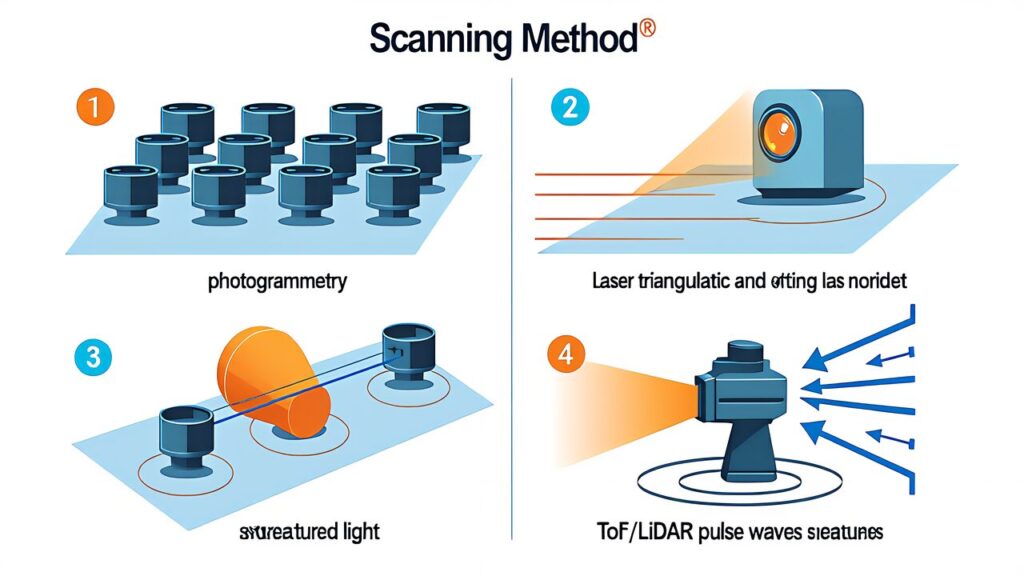
3D scanning divides into contact and non-contact methods. Non-contact splits further into active (projecting energy and measuring reflection) and passive (observing ambient light). This classification forms the foundation of all 3D scanning knowledge.
Photogrammetry reconstructs 3D geometry from multiple 2D photographs by identifying corresponding feature points across images. Requiring only a camera (even a smartphone), it offers the lowest entry barrier. Strengths include natural color capture and scalability from small objects to buildings. Weaknesses: struggles with reflective/transparent/textureless surfaces, requires many overlapping photos, and processing is computationally intensive. Software options range from free (Meshroom, RealityCapture for sub-$1M revenue) to professional (Agisoft Metashape Standard $179, Pro $3,500).
Structured light scanners project known patterns (stripes, grids, or coded dots) onto objects and capture the deformation with cameras. By analyzing pattern distortion, they calculate surface depth with high precision (typically 0.02-0.1mm). Consumer handheld models like Revopoint POP 3 Plus use infrared structured light, while industrial units use blue/white light. Strengths: high precision, fast capture (10-60fps), works in controlled environments. Weaknesses: limited by working distance, struggles with dark/reflective surfaces, requires stationary or slow-moving subjects.
Laser triangulation projects a laser point or line onto the surface and captures its position from a known angle offset. The displacement encodes depth. Metrology-grade scanners achieve 0.01mm or better precision. Used extensively in industrial quality control, reverse engineering, and CMM-integrated inspection. Higher cost and slower scan speed compared to structured light, but superior precision and ability to handle dark/metallic surfaces. Creality CR-Scan Raptor uses multi-line blue laser for consumer-grade triangulation.
Time-of-Flight sensors measure the round-trip time of emitted light pulses to determine distance. iPhone Pro/iPad Pro LiDAR and terrestrial LiDAR scanners use this principle. Strengths: long range (meters to kilometers), real-time operation, works in sunlight. Weaknesses: lower precision (typically ±1-3cm for consumer LiDAR), fewer data points per frame. Best for architectural scanning, room mapping, and large-scale environments rather than precision modeling.
3D Gaussian Splatting (3DGS), emerging from the SIGGRAPH 2023 paper, represents scenes as collections of oriented 3D Gaussians rather than meshes or point clouds. It achieves photorealistic novel-view synthesis from multi-view images at real-time rendering speeds. Unlike traditional 3D scanning methods that output meshes, 3DGS excels at visual fidelity but faces challenges in mesh extraction and precision measurement. Apps like Scaniverse and Polycam now offer 3DGS capture on smartphones, making it accessible to beginners for visualization use cases like virtual tours and AR content.
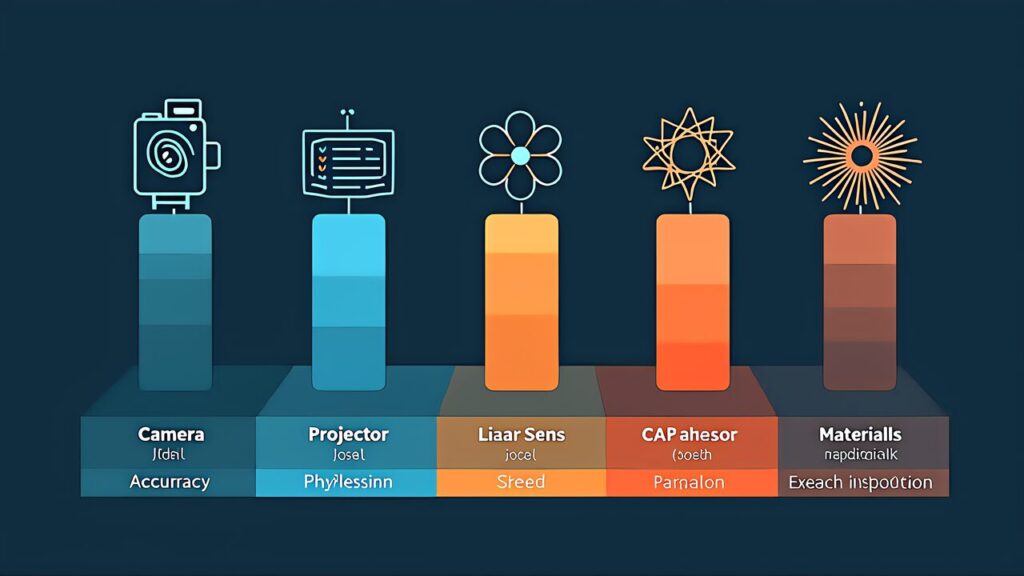
| Method | Precision | Speed | Cost Range | Best For | Weakness |
|---|---|---|---|---|---|
| Photogrammetry | 0.1-1mm | Minutes (processing) | Free-$3,500 | Textured objects, outdoor/architectural | Reflective/transparent surfaces |
| Structured Light | 0.02-0.1mm | 10-60fps real-time | ~$600-$2,500 | Small-medium objects, figurines, parts | Working distance limits, reflections |
| Laser Triangulation | 0.01-0.05mm | Moderate | $1,000-$50,000+ | Industrial QC, reverse engineering | Cost, speed |
| ToF/LiDAR | ±1-3cm (consumer) | Real-time | $0 (phone)-$5,000+ | Rooms, architecture, large scenes | Low precision for small objects |
| Gaussian Splatting | Visual (non-metric) | Minutes | Free-$100/yr | Visualization, VR/AR, virtual tours | Not mesh-native, measurement limited |
Figurines & jewelry (sub-30cm): Structured light scanners like Revopoint POP 3 Plus (~$593, approx. from Amazon.co.jp) or MINI 2 (~$880) deliver the precision needed. Photogrammetry works as a budget alternative with sufficient lighting and texture.
Human body & medium objects (30cm-2m): Revopoint Range 2 (official $729) or Creality CR-Scan Raptor (~$1,167, approx. from Amazon.co.jp) handle the working distance and capture range required. Smartphone photogrammetry apps can supplement for less critical scans.
Architecture & rooms: Smartphone LiDAR (iPhone Pro + Polycam/Scaniverse) provides free room-scale scanning. Professional jobs use terrestrial LiDAR or drone photogrammetry.
Visualization & virtual tours: Gaussian Splatting via Scaniverse (free) or Polycam offers the best visual quality with minimal effort. Not suitable for manufacturing or measurement.
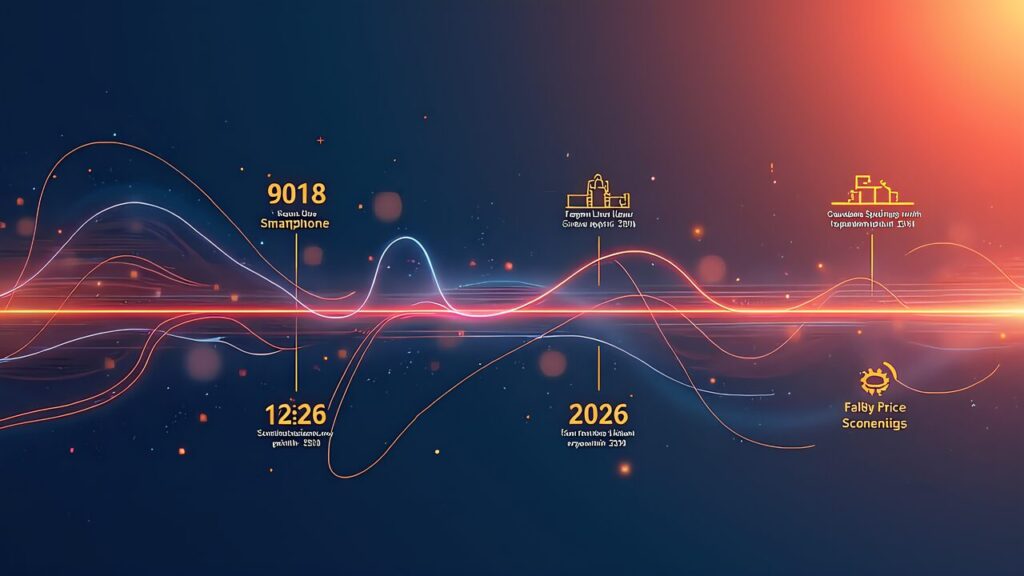
Between 2024 and 2026, three shifts redefined 3D scanning accessibility. First, consumer structured light scanners dropped below $700 while achieving 0.04mm precision — performance that cost $5,000+ just three years ago. Second, smartphone LiDAR became standard on flagship phones, enabling room-scale scanning with zero additional hardware cost. Third, Gaussian Splatting moved from academic paper to one-tap smartphone capture, letting anyone create photorealistic 3D scenes in minutes. The result: 3D scanning is no longer the domain of professionals with $10,000+ budgets. A smartphone owner today has more scanning capability than a studio with $50,000 in equipment had in 2020.
Gaussian Splatting has matured from a research demo to a production-ready visualization tool. Scaniverse, Polycam, and Luma AI offer real-time 3DGS capture and sharing. However, extracting clean meshes from Gaussian splats remains imperfect — surface reconstruction algorithms are advancing but cannot yet match the precision of dedicated structured light scanners. LiDAR on smartphones has plateaued at ±1cm precision, sufficient for room mapping but not for product design or quality control. The sweet spot in 2026: use structured light for precision, LiDAR for scale, photogrammetry for outdoor texture, and Gaussian Splatting for visual storytelling.
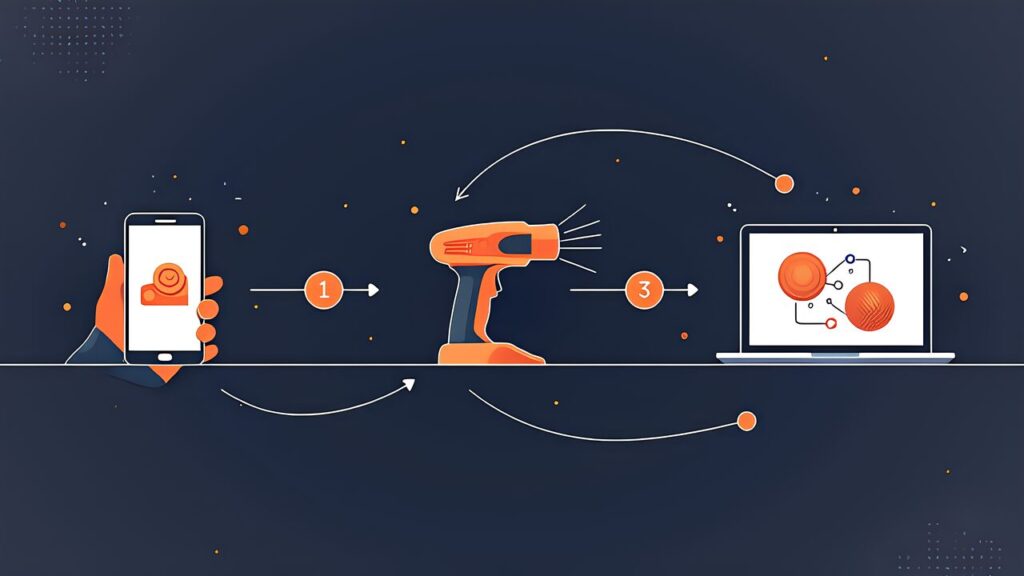
Step 1 — Smartphone scanning (free): Install Scaniverse (free, unlimited) or Polycam (free tier available) on your iPhone/Android. Scan household objects to build intuition for angles, lighting, and overlap. This costs nothing and teaches the fundamentals of multi-view capture.
Step 2 — Dedicated scanner ($600-$900): Once you hit smartphone limits (precision, reflective surfaces), step up to a consumer structured light scanner. Revopoint POP 3 Plus (~$593 from Amazon.co.jp) is the entry-level recommendation for small-medium objects. For larger subjects, consider Range 2 (official $729).
Step 3 — Post-processing pipeline: Raw scans need mesh cleanup. MeshLab (free) handles basic operations. For AI-powered repair, Meshy (free tier: 200 credits/month) automates hole-filling and remeshing. Blender (free) provides manual control when AI falls short. Master this pipeline before investing in higher-end hardware.
An example of an entry-level handheld scanner for step 2.

Text-to-3D and image-to-3D AI models (Meshy, Hyper3D Rodin, Tripo) can generate 3D models from descriptions or photos. These are useful for concept art, game assets, and prototyping when the physical object doesn’t exist yet. However, they cannot replace real scanning when dimensional accuracy, surface fidelity, or legal documentation (cultural heritage, forensics) matters. Use AI generation for “what could be” and real scanning for “what is.” The two workflows are complementary, not competitive — and mastering both gives you the widest creative and professional toolkit in 2026.
Choosing a 3D scanning method isn’t about finding the “best” technology — it’s about matching the method to your subject’s scale, material, and intended use. Start with a free smartphone app, learn the fundamentals through practice, then invest in dedicated hardware only when you’ve identified specific limitations. The 2026 ecosystem offers an entry point for every budget: from free smartphone apps to ~$593 structured light scanners to ~$1,867 standalone units. Follow this series for deep dives into smartphone scanning apps, handheld scanner comparisons, AI mesh repair, scan-to-print conversion, cultural heritage workflows, and the complete 2026 roadmap.