Print When Ordered: How AI × Shopify Enables 3D Print On-Demand Stores
swiftwand swiftwand.ai
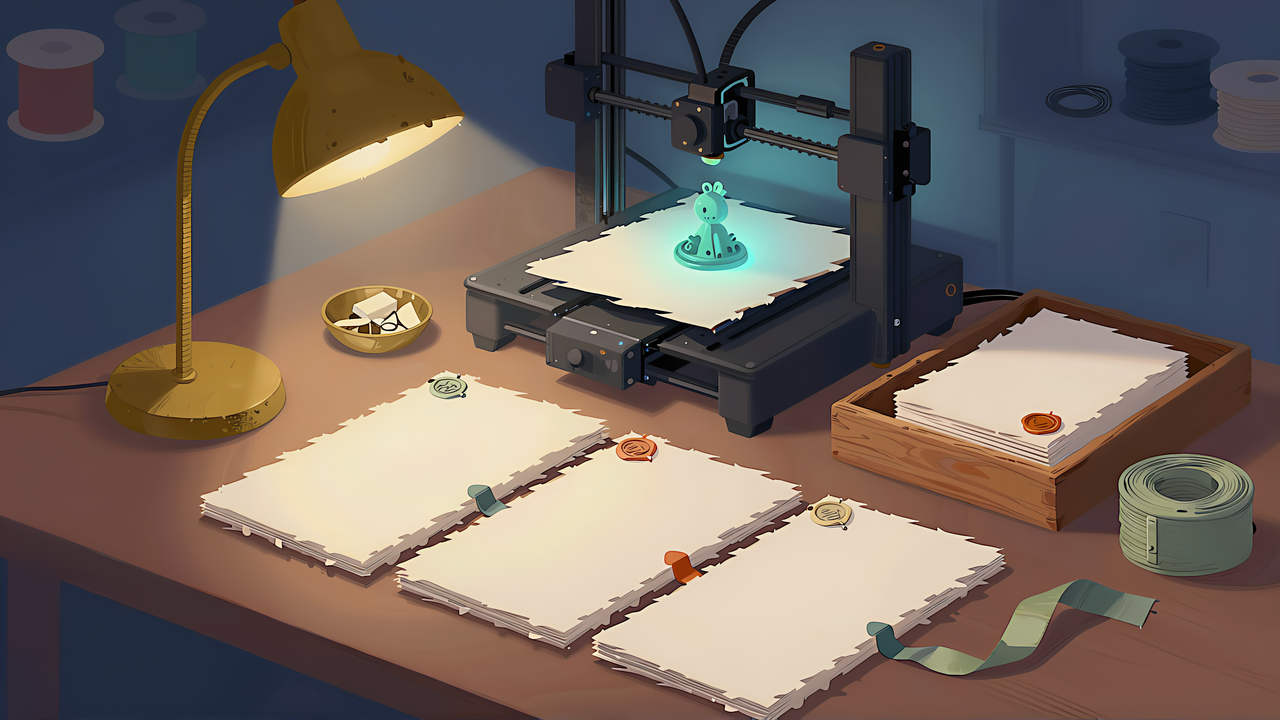
You find a model on a download site, print it, and want to sell the prints at a fair or online. The model page says “CC BY-NC-SA,” “Standard Digital File License,” or “Open Community License v1.1,” and what is allowed is only clear once you open the license text. The legal code of each Creative Commons 4.0 license (sections 1–8) runs roughly 1,900 to 2,200 English words, and site-provided licenses with the same name are worded differently from site to site. Creators sometimes add “no selling” to the description as well. For one model you can simply read it all; across dozens of models, reading 3D model licenses from scratch every time gets heavy.
This article contains affiliate links. As an Amazon Associate, we earn from qualifying purchases.
This article explains how to read the licenses and records a test in which AI judged them. It is not legal advice. Do not decide that a use is allowed based on an AI answer; confirm against the license text and, where needed, with the creator. Creative Commons itself advises contacting the rights holder when you are unsure whether a use is commercial.
We call a model that writes no text and returns probabilities for predefined questions a decision model (see our Jev explainer). We asked the local decision model Nimble 9B (Ollama build) and, for comparison, claude -p (Claude Sonnet 5.5) four questions about 14 licenses available on major download sites, first with the license name only, then with the relevant clauses attached. We added seven cases where a creator wrote extra conditions in the description. The answer key came from the license texts, not from an AI.
In short: attaching the clauses improved both models’ accuracy and probability quality, and claude -p answered all 46 scored questions correctly with clauses. With the name only, both models missed questions about Prusa’s Open Community License (OCL) v1.1. Nimble said “yes, same license required” for CC BY 4.0 and CC BY-NC 4.0 at 0.995 to 0.998 even with the clause attached, which is wrong. On creator add-ons, Nimble pushed 6 of 7 cases close to 0 or 1, while claude -p kept all 7 between 0.62 and 0.85.
On Printables, MakerWorld, and Thingiverse, the uploader picks a license per model. On October 7, 2026, we checked the license filters on each site’s search page. Upload screens require login and were not checked, so this is not an exhaustive list.
| Site | Main licenses in the search filter |
|---|---|
| Printables | Six CC licenses, public domain (links to CC0 1.0), GPL v2.0 and v3.0, Standard Digital File License, Open Community License v1 and v1.1 |
| MakerWorld | Six CC licenses, public domain (links to a CC0 explanation), Standard Digital File License |
| Thingiverse | Six CC licenses, public domain, GNU – GPL (no version shown; the link points to v2.0 but structured data on the same page points to v3.0), All Rights Reserved |
The six CC licenses combine Attribution (BY) with ShareAlike (SA), NonCommercial (NC), and NoDerivatives (ND). On all three sites the linked versions were 4.0 (on Thingiverse we checked only one recent model). Even so, the name alone is hard to act on, for three reasons.
We sent the license shown on the model page plus four noul questions, each returning the probability of “yes.”
| Question | English prompt sent | Meaning |
|---|---|---|
| Q1 Sell prints | May another person sell physical 3D prints made from the unmodified model file? | Can others sell prints of the unmodified file? |
| Q2 Share remix | May another person publish a modified version of the model file for free (non-commercially)? | Can others publish a modified file for free? |
| Q3 Same license | If another person publishes a modified version, must it be released under the same license? | Is a remix required to carry the same license? |
| Q4 Credit | When another person shares the model file or a modified version, must they credit the original creator? | Is attribution required when sharing the file or a remix? |
Each state began with “Assume the 3D model is protected by copyright and the uploader has the right to license it.” Without that premise, the correct answers to Q1 and Q4 wobble. CC licenses do not restrict uses that are lawful without permission (section 8(a)), and a 2016 CC post on 3D printing noted that for “born open” design files CC licenses do not properly apply because copyright does not apply. CC adds that patents, contracts, or terms of use may still restrict use, and licenses like OCL cover designs and patents, so “not copyrightable” does not mean “free to use.” We did not judge whether any individual model is copyrightable. Q1 assumes printing the unmodified file; resizing or reshaping is out of scope. Q4 concerns sharing files, not marking the physical print.
The answer key uses only the license texts and official pages from the issuers (Creative Commons, the Free Software Foundation, Prusa Research) and the download sites. No blogs or forum posts.
| License | Sites | Q1 Sell prints | Q2 Share remix | Q3 Same license | Q4 Credit |
|---|---|---|---|---|---|
| CC0 1.0 | All three | Yes | Yes | No | No |
| CC BY 4.0 | All three | Yes | Yes | No | Yes |
| CC BY-SA 4.0 | All three | Yes | Yes | Ambiguous | Yes |
| CC BY-NC 4.0 | All three | No | Yes (non-commercial) | No | Yes |
| CC BY-NC-SA 4.0 | All three | No | Yes (non-commercial) | Ambiguous | Yes |
| CC BY-ND 4.0 | All three | Yes | No | n/a | Yes |
| CC BY-NC-ND 4.0 | All three | No | No | n/a | Yes |
| GPL v2.0 | Printables, Thingiverse | Yes | Yes | Yes | Yes (copyright notices) |
| GPL v3.0 | Printables | Yes | Yes | Yes | Yes (copyright notices) |
| OCL v1.1 (no add-on) | Printables | No (needs a separate business license) | Yes | Yes | No (version must be stated) |
| OCL v1.1 + GAtt v1 | Printables | No | Yes | Yes | Yes |
| Standard Digital File License | MakerWorld | No | No | n/a | n/a |
| Standard Digital File License | Printables | No | No | n/a | n/a |
| All Rights Reserved | Thingiverse | No (needs permission) | No (same) | n/a | n/a |
Thingiverse’s “GNU – GPL” shows no version, and on the model page we checked the link pointed to v2.0 while the structured data pointed to v3.0, so we tested it as v2.0. “n/a” cells were not scored because the previous question was already “no,” and “Ambiguous” cells were not scored either. The rows most likely to cause disagreement are explained below.
NC licenses limit sharing to NonCommercial purposes, defined as “not primarily intended for or directed towards commercial advantage or monetary compensation.” Selling prints sits squarely inside monetary compensation. The CC FAQ says commerciality depends on context and intent, that anyone wanting commercial use of an NC work should get permission first, and that a rights holder can offer commercial licenses for a fee while publishing under NC.
ND licenses allow you to “produce and reproduce, but not Share, Adapted Material.” Changing dimensions for your own use is allowed by the text; sharing or selling the modified version is not. Prusa’s OCL post puts it the same way: “No Derivatives doesn’t mean you can’t modify a model, it means you just can’t distribute the modified version.” MakerWorld’s upload rules also list “Modifying” as prohibited for works under no-derivatives licenses, but that is a platform rule, not a license term. For selling prints of an ND work, CC says technical modifications needed to change format do not create adapted material (section 2(a)(4)), and its FAQ says format shifting is allowed “even in our NoDerivatives licenses,” with printing a hard copy as the example. That example is not about 3D printing; reading a print as a format change, and marking Q1 “Yes,” is our interpretation.
SA licenses require remixes to use “a Creative Commons license with the same License Elements, this version or later, or a BY-SA Compatible License.” CC’s compatibility list names Free Art License 1.3 and GPLv3 for BY-SA 4.0 and no non-CC license for BY-NC-SA 4.0 (checked October 7, 2026). Because the question says “the same license” but the text allows later versions and compatible licenses, the SA rows for Q3 were marked ambiguous and not scored; both models answered “yes” at 0.93 or above on those four questions. BY and BY-NC, by contrast, say “the Adapter’s License You apply must not prevent recipients of the Adapted Material from complying with this Public License.” That requires compatibility, not the same license, so Q3 is “no.” GPL v2.0 and v3.0 require remixes as a whole under the same GPL, and OCL v1.1 requires distribution under OCL.
GPL v2.0 says “You may charge a fee for the physical act of transferring a copy,” and v3.0 says “You may charge any price or no price for each copy that you convey,” so Q1 is “Yes.” Whether a print counts as a copy under the GPL, and whether selling it would trigger source obligations, is not settled by the text, and we do not decide it here. OCL v1.1 forbids commercial reproduction without a separate business or repair license, says “YOU MAY use, copy, modify, hack the product and/or its components as you wish!”, and requires derivatives under OCL. Attribution is not in the base license (stating the OCL version is); the GAtt v1 add-on makes it required and allows a tag for physical distribution. Both Standard Digital File Licenses forbid selling and sharing remixes; on MakerWorld a creator can sell commercial licenses through a commercial license membership, if they qualify.
Q4 is about sharing files, not putting the creator’s name on the object. A 2016 CC post said “it is debatable whether attribution is legally required on the physical object of a CC-licensed 3D design in the first place,” and we found no later official position, so we left it out of the questions.
For each of the 14 licenses we built two inputs: the license name and site only (“name only”), and the same plus English excerpts of the clauses behind the answer key (“with clauses”). MakerWorld’s Standard Digital File License text was only available in its Japanese display, so it was attached in Japanese. Adding seven creator add-on cases gives 35 cases, each asking Q1 to Q4 together. A question counted as correct when the probability leaned toward the right side; claude -p’s exact 0.5 on OCL v1.1 Q1 (name only) leaned nowhere and was not counted. Excluding 8 n/a and 2 ambiguous questions leaves 46 scored questions per condition. For the add-on cases we looked at one question each.
The request sent to Ollama’s /v1/systemone looked like this (state abbreviated):
{
  "model": "nimble",
  "state": "(premise + site + license name + optional clauses, as one string)",
  "questions": {
    "q1_sell_prints": {"type": "noul", "instructions": "May another person sell physical 3D prints made from the unmodified model file?"},
    "q2_share_modified": {"type": "noul", "instructions": "May another person publish a modified version of the model file for free (non-commercially)?"},
    "q3_same_license": {"type": "noul", "instructions": "If another person publishes a modified version, must it be released under the same license?"},
    "q4_credit": {"type": "noul", "instructions": "When another person shares the model file or a modified version, must they credit the original creator?"}
  }
}| Item | Nimble 9B (Ollama build) | claude -p |
|---|---|---|
| Model | Bespoke Labs 9B decision model (Apache 2.0) | Claude Sonnet 5.5 (–model sonnet, logged as claude-sonnet-5-5) |
| Where it ran | Local RTX 5070 Ti (16,303 MiB), Ollama 0.35.1 for Windows | Anthropic API via Claude Code non-interactive mode, no tools, MCP, or settings files |
| Questions | Four noul questions via /v1/systemone | Same four questions in text; probabilities returned as JSON (system prompt: “You are a careful assistant.”) |
| Probability | Returned by the model | Number written in the reply |
| Runs | Once per case | Once per case |
Tools have licenses too: Nimble’s license depends on the version. The v3 weights on Hugging Face are CC BY-NC 4.0 (non-commercial); we used the Apache 2.0 build distributed by Ollama. We did not send these cases to TypeSafe’s Jev. Ollama’s endpoint follows the Jev API, so the same request shape would work, but TypeSafe says Jev is trained mainly on English and handles CJK text less well, and our add-on cases include Japanese sentences.
Getting probabilities out of a general chat model, as we did with claude -p, comes down to how you write the prompt and the output format. A practical guide to prompt engineering covers those choices.
Each condition ran once on October 7, 2026.
| Model | Condition | Correct (scored only) | Brier (0–1) | Median time per case |
|---|---|---|---|---|
| Nimble 9B | Name only | 41/46 (89.1%) | 0.090 | 2,925 ms |
| Nimble 9B | With clauses | 43/46 (93.5%) | 0.055 | 2,880 ms |
| claude -p | Name only | 43/46 (93.5%) | 0.044 | 5,941 ms |
| claude -p | With clauses | 46/46 (100.0%) | 0.003 | 5,540 ms |
The Brier score averages the squared difference between the predicted probability and the outcome (1 for yes, 0 for no). It runs from 0 to 1, lower is better, and always answering 0.5 scores 0.25. All four results are well below that; claude -p’s 0.003 with clauses means nearly every probability sat at the correct end. Note that claude -p’s probabilities are numbers it wrote in text, not values computed for every option at once as a decision model does.
Time is not a fair comparison: Nimble ran on a local GPU at about 2.9 seconds per case, while claude -p called a remote API and included CLI startup, at 5.5 to 5.9 seconds. claude -p reported a total cost of $0.754 for all 35 cases; Nimble had no API cost (electricity not counted).
With the name only, both models missed OCL v1.1 questions; with clauses, claude -p answered all correctly. OCL v1.1 is new, and its mix of no commercial copying, allowed remixes under OCL, and attribution only through an add-on matches no CC license, so mapping it onto CC fails somewhere. Name-only judgment is reasonable only for well-known licenses; for new or site-provided licenses, attach the clauses.
Nimble answered Q3 for CC BY 4.0 and CC BY-NC 4.0 as “same license required,” with or without clauses, at 0.995 to 0.998 with clauses. Two of its three misses with clauses were these. The attached text included the “must not prevent” sentence, yet the answer was “yes”; we did not investigate why. A probability that high looks like a sure thing, which is exactly why you test on examples with known answers before trusting a decision model.
What happens when a creator adds conditions to a CC license in the description? Official CC positions point in opposite directions depending on whether the addition restricts or expands permissions.
So a restriction such as “no selling” leaves the CC grant in the text but may act as a separate contract, and CC says the result is no longer CC: the answer is ambiguous. An expansion such as “selling is allowed” is clearly permitted. For GPL, section 7 of v3.0 lets recipients remove further restrictions; v2.0 forbids redistributors from imposing further restrictions but does not address restrictions added by the author.
| Case | License | Added sentence (original was Japanese) | Question | Expected | Nimble 9B | claude -p |
|---|---|---|---|---|---|---|
| A1 | CC BY 4.0 | Selling prints is prohibited. | Q1 | Ambiguous | 0.006 | 0.620 |
| A2 | CC BY-NC 4.0 | Selling prints is allowed. | Q1 | Yes | 0.344 | 0.720 |
| A3 | CC BY 4.0 | No credit required. | Q4 | No | 0.008 | 0.620 |
| A4 | CC BY 4.0 | Publishing remixes is prohibited. | Q2 | Ambiguous | 0.005 | 0.800 |
| A5 | GPL v3.0 | No selling. | Q1 | Yes (by the text) | 0.105 | 0.750 |
| A6 | GPL v2.0 | No selling. | Q1 | Ambiguous | 0.097 | 0.680 |
| A7 | Standard Digital File License (MakerWorld) | You may sell prints. | Q1 | Ambiguous | 0.968 | 0.850 |
Values are probabilities of “yes.” A5’s “Yes (by the text)” follows GPL v3.0 section 7, which lets recipients remove the restriction, even though it contradicts the creator’s intent. A7 is ambiguous because the license says no charging “without permission,” but there is no official statement on whether a description line counts as that permission.
Nimble followed the description in 6 of 7 cases, returning 0.006 to 0.105 for “no selling,” 0.005 for “no remixes,” and 0.968 for “you may sell.” Even in the four ambiguous cases its probabilities sat near 0 or 1; it produced no middle values. Of the three cases with a definite answer, only A3 leaned the right way. In A2 the creator explicitly allowed selling under NC, yet Nimble returned 0.344, and in A5 it followed “no selling” at 0.105 despite GPL v3.0 section 7.
claude -p returned 0.62 to 0.85 in all seven cases, moving away from the extremes it used with plain clauses (Brier 0.003). But the middle values did not separate ambiguous cases (0.62–0.85) from definite ones (0.62–0.75), and in A3 it put 0.62 on “credit required,” the wrong side. A middle probability can flag a case for a person, but it does not say which way the answer goes.
From this test, here is a workflow for sorting 3D model licenses with a decision model. The AI narrows down which models a person must read; it is not the basis for deciding a use is allowed.
Two more distinctions help. A license provided by a site, such as the Standard Digital File License, is itself the license; but when a site adds terms on top of a CC work, the CC FAQ says “These additional terms do not form part of the license for the work and may not be applicable to distributions of the work outside of the platform.” And CC licenses do not grant patent or trademark rights (CC0 included): a license may allow selling while a registered design right still blocks it. The decision model only reads license text.
Turning a decision model into a dependable step means building an evaluation set and checking it as the model or prompt changes. A book on engineering applications with foundation models covers that evaluation loop.

 ポチップ
Still, three things come through from these 35 cases: attaching clauses helped both models, new licenses failed by name alone, and the two models reacted to creator add-ons very differently.
A decision model is useful for sorting dozens of licenses down to the ones a person must read. Attach the clauses, send add-on cases and middle probabilities to a person, and make the final call from the license text and the creator. Used that way, it takes much of the weight out of reading every license every time. Related in this series: settings checks before printing and choosing between the Jev API and local models.