Print When Ordered: How AI × Shopify Enables 3D Print On-Demand Stores
swiftwand swiftwand.ai
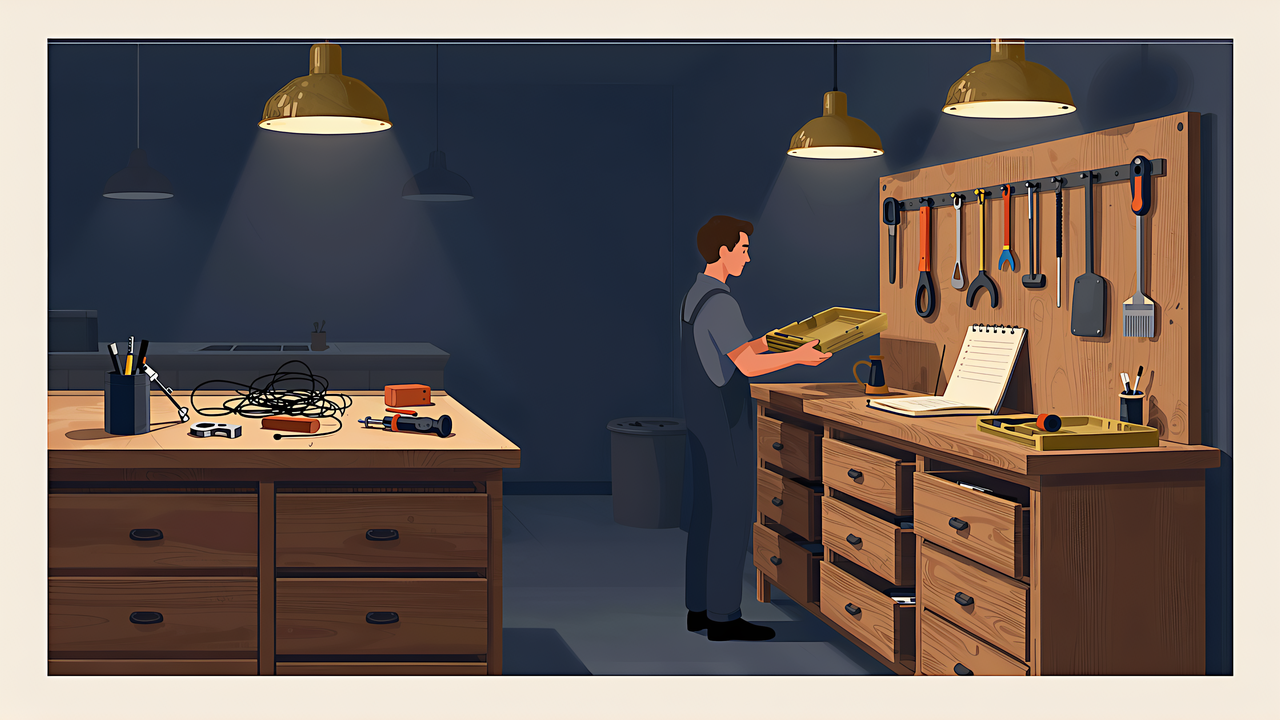
When you decide to build your own storage, the first obstacle is not technical. It is that you cannot pick a starting point. The drawers are a mess and the walls are empty. The tools and the parts both sit badly. Try to do all of it and the weekend goes to deciding where to begin.
This article contains affiliate links. As an Amazon Associate, we earn from qualifying purchases.
Rebuilding a workspace proceeds steadily once the order is fixed. Each stage is independent, and stopping halfway still leaves you with the parts already built. What you need is not a master plan but a rule for choosing the first move.
This article reorganises the series into three reverse lookups: by surface, by what you want to store, and by whether you plan to distribute. Answer any one of them and the next task is decided.
The reason people stall is usually a mis-scoped estimate. Framed as tidy the workshop, the target is several hundred objects and there is no visible end. Framed as this one drawer, the target is a few dozen and the process, measure, divide, print, is concrete. Do not treat organising as a single project; break it into independent small jobs. That is the condition under which hands actually start moving.
The simplest entry point is which area you want to clear.
| Area to clear | Standard family | What to make first |
|---|---|---|
| Inside a drawer | Horizontal grid, 42 mm units | One thin gauge, then divided bins |
| On the desk | The same. Baseplate optional | Cradles for the tools you use most |
| A wall | Vertical grid, 28 mm spacing | One board plus a few hanging parts |
| Desk side or door interior | A thin board of the vertical standard | One thin board |
Starting from a drawer costs the least when it goes wrong. There is no mounting problem, no lease to consider. Measure, divide, print, insert, and it is done.
Which drawer also has a rule: pick the one you open most often. You feel the benefit every day, which sustains the motivation to make the next one. Start with a drawer you rarely open and the effort produces little visible change. Rebuilding a workspace is a long campaign, so choosing an order that keeps momentum is itself a practical decision.
Starting from a wall means more to check before printing: stud positions, fastener selection, restoration terms. Those are in the wall mounting article.
The other entry is the thing that bothers you most. What is in the box decides how you make it.
| What you are storing | Approach | Why |
|---|---|---|
| Screws, bits, small consumables | Generic divided bins, generated | The content is space, not shape |
| Hand tools you use daily | Cradles shaped to the outline | The content is a shape, and it should not roll |
| Cables and adapters | Divided bins, measured with the coil decided | The dimension is a decision, not a fact |
| Rarely used spares | Lidded boxes, or a wall | Dust, and value of the floor space they occupy |
If the content is space, generate. If the content is a shape, either find a model or trace one. That single distinction sorts most cases, and it is the reason the generator families divide the way they do. The comparison is in the parametric generator article.
For shaped cradles, the question becomes how to obtain the outline. Calipers and a polygon work. So does extracting it from a photograph, and the mechanism and limits of that are in the article on tracing tool outlines from photos. The division of labour does not change: the machine gives you an outline, and clearance and finger access remain yours.
This is the branch closest to real consequences. If there is any chance you publish the data or sell printed items, the choice of standard becomes a constraint.
| Plan | What to check |
|---|---|
| Personal use only | Effectively unconstrained. Any standard works |
| Giving printed items away | The standard license. Whether attribution is required |
| Selling printed items | Commercial terms. Whether an agreement is needed and any cap |
| Distributing or selling data | Whether originals may be redistributed, and the terms on derivatives |
The three main standards differ in which of those rows first imposes a limit. One is MIT and effectively free, one requires attribution, one requires a commercial subscription and forbids redistributing the originals. And a permissive standard can still sit under a generator carrying a non-commercial clause. The terms as actually written are in the grid standards comparison and the generator comparison.
Check in the order standard, generator, output data. It takes a minute and undoes dozens of hours if you do it late.
Plans change, which is the thing to watch. You intend it for yourself, then you show someone what you made and they want one. If you never checked the terms, you are choosing between refusing and rebuilding. If there is any future possibility at all, the permissive standard is the safer default, and keeping your options open costs nothing.
If you are on a standard with an attribution requirement, decide in advance where the attribution goes. Distributing data means the description; selling prints means the product page. It looks like a chore and takes one line. Selling data specifically is covered in the STL data selling article.
The work splits into measuring, generating, and printing. Measuring and generating are minutes to an hour of human time. Printing is dozens of hours of machine time and very little of yours. Framed that way, the human cost is lower than it first appears, and running the machine overnight lowers it further.
The specifics of measuring are in the article on measuring drawers and equipment, and the settings and estimates for printing a batch are in the batch printing article.
The two things you actually need first: a caliper and filament.
When the first drawer works, you want to do the next. The sticking points are predictable.
You cannot reproduce the settings. Three months later you want ten more and cannot recall the dimensions you used. Generator settings, slicer profile, filament brand and colour. Without a record, neither texture nor dimensions match.
Colours do not match. A change of filament lot shifts the colour slightly and it shows when the bins sit together. Calculate the quantity in advance and buy it together.
You want to switch standards. Using the system reveals that another one suited you better. Switching means every box printed so far is wasted, which is why the terms are worth checking at the first choice.
Extending into shared space changes the rules. On a shelf used by family or colleagues, other people need to know where things return to. Shaped cradles are good at this because the shape decides the answer. A row of similar divided boxes just gets things dropped into the nearest one. Shared spaces need shape or labels to distinguish things.
The leftover strip stays leftover. Space outside the grid gets ignored until it has a purpose. Decide up front whether it holds long thin items or stays deliberately empty, and it stops nagging.
Seven articles, in order:
Rebuilding a workspace stalls on choosing a starting point, not on technique. To recap: